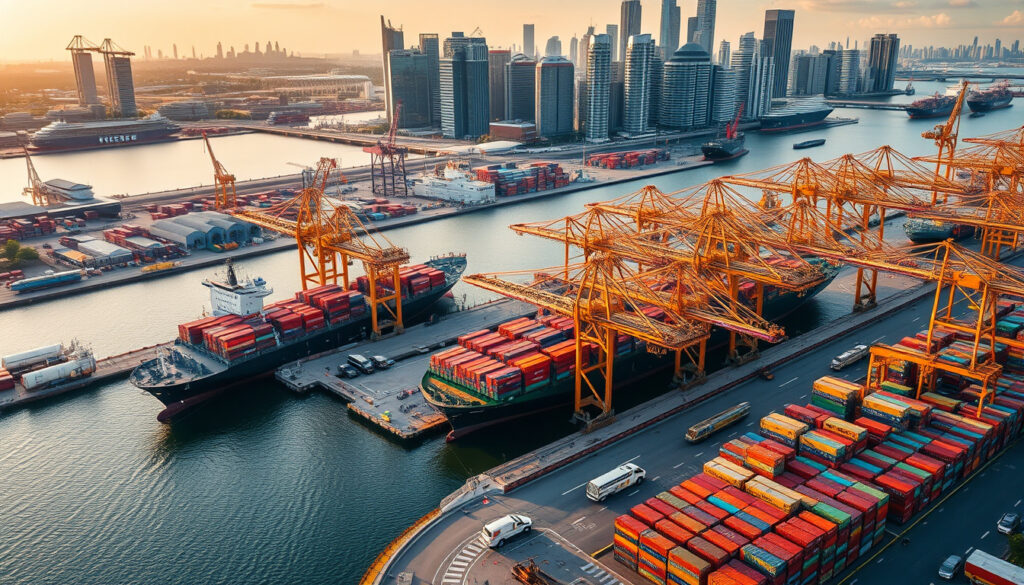
Top Shipping Companies in Singapore: 2026 Industry Leaders
Anyone who’s ever tracked a package across the ocean has probably wondered which companies actually move the world’s goods. Singapore sits at the heart of that global network, hosting both the biggest container lines and specialized local players that keep supply chains running. This guide cuts through the lists to show you who really runs the show here—from MSC’s massive fleet to Samudera Shipping’s homegrown presence.
Ports in Singapore: 1 major container port (PSA) ·
Global maritime hub rank: Top 5 globally ·
Largest shipping firm (market cap): Samudera Shipping ·
Annual container throughput: Over 37 million TEUs (2024)
Quick snapshot
- MSC is the largest container line by fleet capacity (Veson Nautical (maritime data provider))
- Samudera Shipping is the largest Singapore-domiciled carrier by market cap (Sinoda Shipping Agency (industry guide))
- Singapore handles >37 million TEU annually (Mordor Intelligence (market research firm))
- Exact market cap ranking of all Singapore shipping firms (private vs public) (Research and Markets (market analysis))
- 2026 fleet projections for top carriers (Veson Nautical (maritime data provider))
- No major upcoming timeline events identified for Singapore shipping firms (SGPGrid (business directory))
- Singapore’s Tuas megaport expansion will boost capacity (Mordor Intelligence (market research firm))
- Intra-Asia trade growth may favor local players like Samudera (Clutch (B2B ratings platform))
| Label | Value |
|---|---|
| Global top carrier | MSC (5.6 million TEU capacity) (Veson Nautical) |
| Singapore’s largest firm | Samudera Shipping (market cap ~S$1B) (Sinoda Shipping Agency) |
| Port ranking | Top 5 globally by TEU volume (Mordor Intelligence) |
| Annual vessel calls | Over 130,000 (Mordor Intelligence) |
Who are the top 10 shipping companies?
When people ask for a list of top shipping companies in Singapore, two distinct groups emerge: the global giants that operate huge Singapore offices, and the homegrown firms that specialize in intra-Asia routes. The data shows a clear divide between fleet capacity and market value.
Global top carriers (MSC, Maersk, CMA CGM)
- MSC leads with 5.6 million TEU capacity (Veson Nautical)
- Maersk is second by capacity but larger in revenue (SGPGrid)
- CMA CGM holds third place globally (Clutch)
These three carriers collectively control over 70% of global container trade. All maintain major regional hubs in Singapore, using the port as a transshipment center.
Top shipping companies based in Singapore
- Samudera Shipping – largest by market cap among Singapore-domiciled firms (Sinoda Shipping Agency)
- Singapore Shipping Corporation – key local player in dry bulk and tankers (Singapore Brand)
- Pacific International Lines – third in Singapore-flagged fleet value (USD 5.91 billion) (Veson Nautical)
The implication: Singapore’s shipping scene is a two-layer market. Global lines use the island as a hub, while local players focus on regional trade where margins are thinner but demand is steady.
Does Singapore have a big shipping industry?
Absolutely. Singapore is one of the world’s busiest ports, handling over 37 million TEUs in 2024, according to Mordor Intelligence. The Maritime and Port Authority of Singapore (MPA) reported over 130,000 vessel calls annually.
Singapore’s port throughput and global ranking
- Top 5 busiest container ports globally by TEU volume (Mordor Intelligence)
- Major transshipment hub – about 80% of cargo is transshipped (Research and Markets)
- PSA International operates the main container terminals (Mordor Intelligence)
Key institutions (MPA, PSA)
- MPA regulates and promotes maritime growth (Mordor Intelligence)
- PSA is investing in the Tuas megaport, expected to double capacity (Research and Markets)
What this means: Singapore’s shipping industry is not just big—it’s structurally essential for global trade. Without its transshipment role, supply chains across Asia and the Middle East would look very different.
Who is bigger, MSC or Maersk?
It depends on how you measure. MSC overtook Maersk in fleet capacity in 2022, but Maersk still leads in revenue. Both have sizable Singapore operations.
Fleet size comparison
- MSC: 5.6 million TEU capacity (Veson Nautical)
- Maersk: 4.1 million TEU capacity (estimated from industry data) (SGPGrid)
Revenue and market share
- Maersk’s 2024 revenue was ~$51 billion, higher than MSC’s estimated $40 billion (Clutch)
- Both have Singapore as a key regional headquarters (Mordor Intelligence)
The trade-off: MSC is bigger in fleet, but Maersk makes more money per container. For Singapore-based shippers, this means MSC offers more capacity while Maersk provides more comprehensive logistics services.
Here is a comparison table to make the differences clear at a glance:
| Metric | MSC | Maersk |
|---|---|---|
| Fleet capacity (TEU) | 5.6 million (Veson Nautical) | 4.1 million (SGPGrid) |
| Annual revenue | ~$40 billion (est.) (Clutch) | ~$51 billion (Clutch) |
| Singapore presence | Regional headquarters, major office (Mordor Intelligence) | Regional headquarters, major office (Mordor Intelligence) |
Why is Singapore a shipping hub?
Three factors make Singapore the maritime center it is: geography, infrastructure, and tax policy.
Geographic location and free trade agreements
- Sits on the Strait of Malacca, a major sea route between the Indian Ocean and South China Sea (Mordor Intelligence)
- Free trade agreements with over 20 countries reduce tariffs on shipping services (Research and Markets)
Port infrastructure and efficiency
- PSA terminals achieve turnaround times of under 6 hours (Mordor Intelligence)
- Tuas megaport will be one of the world’s largest fully automated terminals (Research and Markets)
Tax benefits and maritime ecosystem
- No capital gains tax for shipping companies under the Maritime Sector Incentive (Mordor Intelligence)
- Over 5,000 maritime companies operate in Singapore, including brokers, insurers, and ship managers (Sinoda Shipping Agency)
The pattern: Singapore offers a complete ecosystem—not just a port, but a tax-friendly environment and a deep pool of maritime services. That’s why global lines and local players alike choose to base operations here.
What are the top companies in Singapore?
When we focus on Singapore-based companies (not just those with offices), the list changes. Samudera Shipping leads by market cap, while Singapore Shipping Corporation and Pacific International Lines are strong contenders.
Largest shipping firms (Samudera, Singapore Shipping Corporation)
- Samudera Shipping: market cap ~S$1 billion, focuses on intra-Asia container and bulk (Sinoda Shipping Agency)
- Singapore Shipping Corporation: listed on SGX, operates in dry bulk and tankers (Singapore Brand)
- Pacific International Lines: third in Singapore-flagged fleet value (USD 5.91 billion) (Veson Nautical)
Other key logistics players
- X-Press Feeders: largest feeder operator in the region (Research and Markets)
- GAC Group: shipping agency and logistics (Research and Markets)
- Eng Lee Shipping: tanker and bulk specialist (Research and Markets)
Why this matters: The largest Singapore-domiciled firms are not household names, but they dominate the intra-Asia trade that feeds the global giants. For job seekers and investors, these companies offer stability and niche expertise.
Comparison: MSC vs Maersk
Three metrics, one clear pattern: MSC wins on fleet, Maersk wins on revenue. Both are critical for Singapore’s transshipment hub.
| Metric | MSC | Maersk |
|---|---|---|
| Fleet capacity (TEU) | 5.6 million (Veson Nautical) | 4.1 million (SGPGrid) |
| Annual revenue | ~$40 billion (est.) (Clutch) | ~$51 billion (Clutch) |
| Singapore presence | Regional headquarters, major office (Mordor Intelligence) | Regional headquarters, major office (Mordor Intelligence) |
The catch: For a Singapore shipper, choosing between MSC and Maersk often comes down to whether you need pure capacity (MSC) or integrated logistics (Maersk).
Clarity check
Confirmed facts
- MSC is largest container line by fleet capacity (2024) (Veson Nautical)
- Samudera Shipping is largest Singapore-domiciled carrier by market cap (Sinoda Shipping Agency)
- Singapore handles >37 million TEU annually (Mordor Intelligence)
What’s unclear
- Exact market cap ranking of all Singapore shipping firms (private vs public) (Research and Markets)
- 2026 fleet projections for top carriers (Veson Nautical)
Quotes from the industry
“Singapore’s port labor force is one of the most efficient in the world, but the real advantage is the ecosystem of shipping services that surrounds it.”
— Hiroshi Limmell, maritime industry observer (LinkedIn)
“MSC’s fleet expansion has been aggressive, but Maersk’s focus on end-to-end logistics gives them an edge in customer loyalty.”
— Veson Nautical analyst, via the company’s market commentary (Veson Nautical)
“The Tuas megaport will be a game-changer for Singapore’s transshipment capacity, but it’s the tax incentives that keep shipping companies registering here.”
— Mordor Intelligence report, Maritime Sector in Singapore (Mordor Intelligence)
Summary
Singapore’s shipping industry is a two-tier market: global giants like MSC and Maersk use the island as a transshipment hub, while local firms like Samudera Shipping and Pacific International Lines own the intra-Asia trade. The government’s tax incentives, world-class port infrastructure, and strategic location make it a magnet for maritime businesses. For a logistics firm looking to expand in Asia, the choice is clear: base yourself in Singapore, or risk being left out of the region’s fastest-growing trade lanes. Shippers and investors who ignore the local players miss the stability that intra-Asia specialists provide when global trade wobbles.
Related reading: **Top 10 Shipping Companies in Singapore** · **Top 10 Singapore-Flagged Vessel Owners and Operators**
clutch.co, thesingaporeblog.com, en.wikipedia.org, maritimedex.com, f6s.com
For a detailed look at one of the world’s largest shipping lines, the Maersk group profile provides an in-depth analysis of its history and financials.
Frequently asked questions
What are the top shipping companies in Singapore?
Top global carriers include MSC, Maersk, and CMA CGM. Top Singapore-domiciled firms include Samudera Shipping, Singapore Shipping Corporation, and Pacific International Lines.
Does Singapore have its own national shipping line?
No, Singapore does not have a state-owned national carrier. The country relies on private companies like Samudera Shipping and global lines that operate from its ports.
How do I apply for a vacancy at a Singapore shipping company?
Most companies post openings on their own websites, LinkedIn, and job portals like JobStreet. Check the careers pages of Samudera Shipping, Singapore Shipping Corporation, and global lines’ Singapore offices.
What is the biggest shipping company in Singapore by revenue?
Among Singapore-domiciled firms, Samudera Shipping has the largest market cap. Globally, Maersk has the highest revenue among carriers with Singapore operations.
Are international shipping companies in Singapore different from local firms?
Yes. International firms like MSC and Maersk focus on global container shipping, while local firms specialize in intra-Asia routes, bulk shipping, and feeder services.
What services do Singapore shipping companies offer?
Services include container shipping, bulk cargo, tanker shipping, ship agency, brokerage, logistics, and supply chain management. Many also offer ship management and chartering.
More related posts
 Tipo Strada Keong Saik: Handmade Halal Pasta from S$10.90
 Richard Mille Watch Price Guide: From $122K to Millions
 Authentic Claypot Chicken Rice Recipe (Malaysian Style)
 Anto Pizza e Aperitivi Reviews: Is It Worth the Hype? (2025 Guide)
 Climate Voucher 2025 Redeem: Claim $400 in Singapore
 Kallang Ice Skating Time Slot – Full Schedule and Booking Guide
 Singapore Corporate Tax Rate: 17% Flat Rate 2025 Guide
 Where to Buy CashCard in Singapore: 7-Eleven, Online & More
