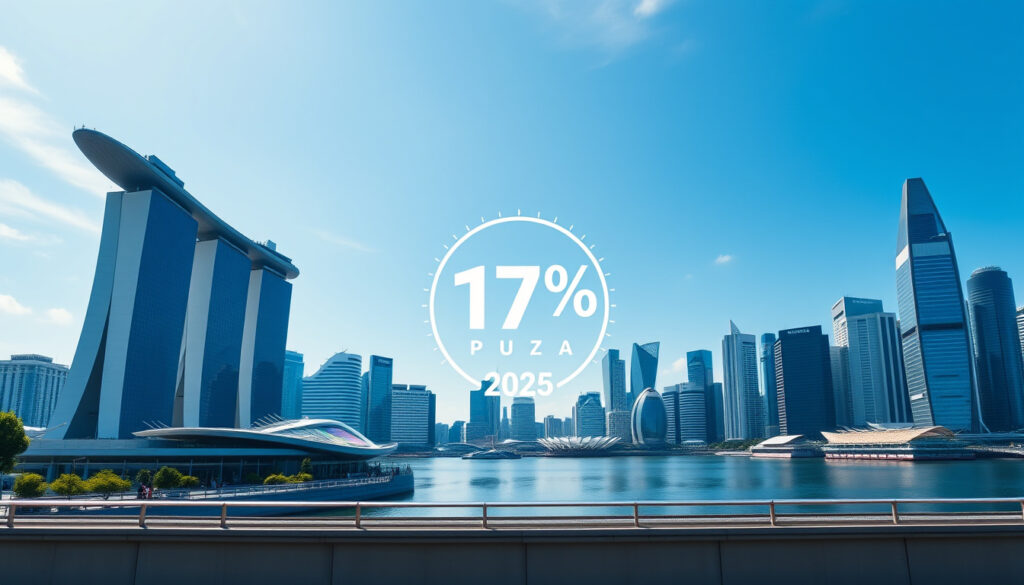
Singapore Corporate Tax Rate: 17% Flat Rate 2025 Guide
Singapore catches a lot of attention for its tax system — and plenty of misconceptions along with it. No, Singapore isn’t a zero-tax jurisdiction, and yes, the 17% corporate rate is real. But here’s what many overlook: that flat rate actually places Singapore among the most compliant, OECD-whitelisted systems in Southeast Asia, not the shadowy fringe. This guide cuts through the noise to show exactly what companies pay, what startups can save, and which incentives from Budget 2025 matter most.
Flat Corporate Tax Rate: 17% · Applies To: Local and Foreign Companies · Startup Exemption Period: 3 Years Partial · Tax Basis: Chargeable Income (Profit) · ASEAN Comparison: Lowest Rate
Quick snapshot
- 17% flat rate per IRAS
- Tax on profits, not revenue per PwC Tax Summaries
- SUTE max exemption SGD 125,000/year per VJM Global
- Exact YA 2026 changes beyond PwC projections
- Future tweaks to exemption thresholds
- Specific qualifying criteria for “active company” rebate condition
- YA 2020: SUTE enhanced to SGD 125k cap per VJM Global
- Budget 2023: EIS introduced per Piloto Asia
- YA 2025: 50% rebate + SGD 2,000 grant per Grant Thornton
- YA 2026: 40% rebate, SGD 1,500 grant per PwC Tax Summaries
- RIE 2025 plan ends December 2025 per Economic Development Board
- Steady 17% projected for 2026 per PwC Tax Summaries
The table below summarizes Singapore’s key corporate tax parameters across all company types.
| Label | Value |
|---|---|
| Standard Rate | 17% |
| Tax Year | 1 Jan – 31 Dec |
| Foreign Companies | Same 17% |
| Startup Relief | Up to SGD 225,000 effective 0% |
| Historical Average | 19.43% (1997–2026) |
| SUTE First Tier | 75% on SGD 100,000 |
| SUTE Second Tier | 50% on SGD 100,000 |
| SUTE Duration | 3 consecutive YAs |
| PTE First Tier | 75% on SGD 10,000 |
| PTE Second Tier | 50% on SGD 190,000 |
| YA 2025 Rebate | 50% capped SGD 40,000 |
| YA 2025 Grant | SGD 2,000 cash |
Is Singapore a tax haven?
Singapore frequently surfaces in “tax haven” searches, but the label misunderstands what the city-state actually offers. A tax haven typically implies zero or near-zero rates, bank secrecy, and minimal transparency — characteristics Singapore explicitly rejects. Singapore’s corporate tax rate stands at a flat 17% of chargeable income, and the jurisdiction fully complies with OECD exchange-of-information standards.
Tax Haven Criteria
Global frameworks for identifying tax havens focus on zero or minimal taxation, lack of transparency, and arrangements that shift profits without real economic activity. Singapore fails the first test outright — a 17% flat rate sits well above zero. It also satisfies the OECD’s Common Reporting Standard and Country-by-Country reporting requirements, placing it on the organization’s whitelist rather than its grey or black lists.
Singapore’s 17% corporate tax rate disqualifies it from the traditional “tax haven” definition. What makes it competitive is not absence of tax, but low-rate simplicity and a broad treaty network that prevents double taxation.
Singapore vs Global Standards
Compare Singapore’s 17% against regional neighbors: Malaysia charges 24%, Indonesia ranges from 12.5% to 22%, and the Philippines applies 25% to domestic corporations. ASEAN’s next-lowest competitor is Cambodia at 20%, making Singapore the bloc’s most competitive rate for both local and foreign companies. The PwC Tax Summaries confirm this positioning in their corporate tax rate comparison across Asia-Pacific.
What Makes Singapore a Tax Haven?
“Tax haven” is the wrong frame. Singapore’s appeal for businesses comes from three interlocking advantages: a genuinely low flat rate, generous startup exemptions that reduce effective rates below 10% in early years, and a network of innovation incentives — particularly the Enterprise Innovation Scheme (EIS) and Double Tax Deduction for Internationalisation (DTDi) — that reward specific business activities rather than wealth storage.
Low Corporate Rate Factors
Singapore’s 17% represents the effective headline rate, not a starting point that gets inflated through surcharges. A company earning SGD 1 million in chargeable income pays exactly SGD 170,000 — no provincial add-ons, no additional levies. The PwC Tax Summaries confirm this straightforward calculation, noting that Singapore is one of few jurisdictions where the stated rate is the actual rate. For context, the United States federal rate sits at 21% plus state taxes that push the combined burden toward 30%, while Australia’s 30% (or 25% for base rate entities) still exceeds Singapore’s flat structure.
Incentives and Exemptions
Beyond the headline rate, Singapore layers targeted incentives that matter more for startups and SMEs than for established firms. The Startup Tax Exemption Scheme (SUTE) offers 75% relief on the first SGD 100,000 of chargeable income and 50% on the next SGD 100,000 for the first three consecutive Years of Assessment. According to VJM Global, this structure creates a maximum annual exemption of SGD 125,000 per year from YA 2020 onwards — meaning a qualifying startup with SGD 200,000 in chargeable income pays tax on only SGD 75,000, yielding an effective rate well below the nominal 17%.
The Partial Tax Exemption (PTE) provides ongoing relief for companies beyond their startup phase: 75% exemption on the first SGD 10,000 and 50% on the next SGD 190,000 of chargeable income. This applies to all companies — foreign branches included — providing continuous relief regardless of age.
SUTE excludes property development and investment holding companies, and requires that control and management be exercised in Singapore to maintain tax residency status. Companies incorporated abroad but operating in Singapore cannot claim SUTE — they access only PTE.
Is Singapore corporate tax on profit or revenue?
Singapore taxes profits, not revenue. This distinction matters enormously for high-revenue, low-margin businesses like certain trading operations or platform companies. Corporate Income Tax applies to chargeable income, which IRAS defines as income after deducting all allowable expenses from gross revenue. The tax is assessed on the preceding year basis — meaning income earned in calendar year 2024 becomes the basis for YA 2025 assessments.
Chargeable Income Definition
Chargeable income excludes cost of goods sold, operating expenses, capital expenditure, and donations. Allowable deductions include employee salaries, rental payments, depreciation of assets, and R&D costs. A company with SGD 5 million in revenue but SGD 4.6 million in allowable expenses pays tax only on the SGD 400,000 difference. This “profits-first” principle aligns Singapore with OECD standards and distinguishes it from jurisdictions that tax gross receipts regardless of profitability.
Deductions Allowed
Singapore’s tax code permits deductions for ordinary business expenses, but excludes capital losses, personal expenses, and fines or penalties. The Enterprise Innovation Scheme (EIS) enhances these deductions significantly: qualifying R&D expenditure, IP licensing costs, staff training, and automation investments can earn up to 400% tax deductions, with an optional 20% cash payout capped at SGD 20,000 annually. According to the Economic Development Board, EIS was introduced in Budget 2023 and enhanced for YA 2024, making Singapore particularly attractive for knowledge-intensive startups.
Singapore’s territorial system means foreign-sourced income is generally exempt if remitted to Singapore, but Singapore-sourced income faces 17% regardless of where the company is incorporated.
Singapore corporate tax rate for foreign companies
Foreign companies face the same 17% flat rate as local entities — but eligibility for startup exemptions diverges sharply. Foreign-incorporated companies operating through Singapore branches pay 17% on Singapore-sourced income and qualify for Partial Tax Exemption, but cannot access the Startup Tax Exemption Scheme.
Same Rate as Locals
The IRAS guidance explicitly states: “A foreign company or its Singapore branch cannot claim the tax exemption for new start-up companies as they are not incorporated in Singapore.” This applies even if the Singapore operation generates entirely local income and employs Singapore residents.
However, foreign-owned companies that incorporate locally — forming a Singapore subsidiary rather than a branch — can qualify for SUTE if they meet standard eligibility criteria: no more than 20 shareholders, at least one individual holding at least 10% of shares, and tax residency with control/management exercised in Singapore. According to Sleek, this creates a meaningful planning opportunity: foreign investors can structure as incorporated subsidiaries to access startup relief.
Branch vs Subsidiary
A branch is treated as a foreign entity extension; a subsidiary is a Singapore-incorporated company. The practical tax difference: branches access only PTE (ongoing relief), while subsidiaries meeting SUTE criteria enjoy three years of enhanced exemptions. For a foreign company expecting SGD 150,000 in annual chargeable income from Singapore operations, the subsidiary route could yield roughly SGD 20,000–40,000 in annual tax savings during the startup period compared to branch treatment.
“Foreign-owned companies incorporated and tax resident in Singapore can qualify for SUTE.”
Singapore corporate tax exemptions and incentives
Singapore’s incentive landscape extends well beyond SUTE and PTE. Budget 2025 introduced enhanced rebates and new grants that directly impact YA 2025 tax obligations, while innovation schemes target specific business activities regardless of company age or size.
Startup Tax Exemption
SUTE applies to companies incorporated in Singapore, tax resident, with no more than 20 shareholders and at least one individual holding at least 10% of shares. It excludes investment holding companies and property development companies. The scheme runs for three consecutive Years of Assessment, with the Grant Thornton analysis confirming the current structure caps annual exemption at SGD 125,000 from YA 2020 onwards.
A worked example: qualifying startup with SGD 250,000 chargeable income in first YA pays tax on SGD 112,500 (25% of SGD 200,000 after first-tier relief, plus 50% of next SGD 100,000), yielding tax of approximately SGD 19,125 — an effective rate under 8% rather than 17%.
Partial Exemption Scheme
PTE provides ongoing relief for all companies not claiming SUTE or those beyond their startup period. The structure — 75% on first SGD 10,000 and 50% on next SGD 190,000 — means a company with SGD 200,000 chargeable income pays tax on SGD 100,000, resulting in SGD 17,000 tax versus SGD 34,000 without the exemption. Razorpay confirms this ongoing relief applies indefinitely, making PTE a permanent feature of Singapore tax planning.
The practical implication: structure choice at incorporation determines which relief a foreign-owned company can access. Branch status means PTE only from day one; incorporated subsidiary status unlocks SUTE for the first three years, then reverts to PTE thereafter.
Singapore Corporate Tax Timeline
Singapore’s corporate tax trajectory shows deliberate reduction from historical highs to a stable modern rate. Understanding this history clarifies why 17% feels competitive now and what to expect going forward.
The timeline below tracks key policy milestones that shaped Singapore’s current corporate tax framework.
| Period | Event |
|---|---|
| 1997–2026 | Average rate 19.43%, with all-time high peak |
| YA 2020 onwards | SUTE enhanced structure introduced |
| Budget 2023 | Enterprise Innovation Scheme (EIS) introduced |
| YA 2024 | EIS enhanced |
| Budget 2025 | Rebates and grants extended |
| Current | Flat 17% established |
| YA 2025 | 50% rebate capped SGD 40,000 + SGD 2,000 grant |
| YA 2026 | 40% rebate capped SGD 30,000 + SGD 1,500 grant |
The implication: Singapore has compressed its corporate tax rate progressively since the 1990s, settling at 17% as a competitive equilibrium rather than a temporary concession. The PwC Tax Summaries project steady 17% through 2026, with incremental relief shifts in rebate structure rather than rate changes.
Confirmed Facts and Open Questions
Singapore’s corporate tax framework is well-documented through official sources, but certain future-facing details remain less specified than they might appear.
Confirmed
- 17% flat rate per IRAS and PwC confirmed across five+ sources
- SUTE structure: 75%/50% on SGD 100k/100k for first 3 YAs, max SGD 125k/year
- Foreign branches: PTE only, no SUTE
- YA 2025: 50% rebate capped SGD 40,000 + SGD 2,000 cash grant
- Corporate tax on profits, not revenue
- OECD-compliant, whitelisted jurisdiction
Unclear
- Exact YA 2026 changes beyond PwC summary
- Future tweaks to exemption thresholds
- Specific qualifying criteria for “active company” in rebates
- Whether RIE 2026 plan will extend R&D commitments beyond 2025
What Experts Say
“Singapore’s Corporate Income Tax rate is 17%.”
— Inland Revenue Authority of Singapore
“All eligible companies will enjoy a cash grant of SGD 2,000. In addition, all taxpaying companies will get a rebate of 50% of their tax payable.”
— Grant Thornton (professional services firm, Budget 2025 analysis)
“New 50 per cent Corporate Income Tax rebate – This supports companies’ cash flow needs, capped at S$40,000 per company for the Year of Assessment 2025.”
— Economic Development Board (government agency, business insights)
Related reading: Register Company in Singapore – 2025 Guide Costs Requirements
Frequently Asked Questions
What is the current Singapore corporate tax rate?
Singapore applies a flat 17% rate on chargeable income for all companies, regardless of whether they are locally incorporated or foreign-owned branches. This rate has remained steady through 2025 and is projected to stay at 17% through at least 2026.
Is Singapore corporate tax the same for startups?
Yes in principle — the 17% rate applies universally. However, qualifying startups access the Startup Tax Exemption Scheme (SUTE), which reduces effective rates to below 10% in early years by exempting 75% of the first SGD 100,000 and 50% of the next SGD 100,000 of chargeable income for three consecutive YAs.
What is chargeable income for Singapore corporate tax?
Chargeable income is profit after deducting all allowable expenses from gross revenue. Singapore taxes profits, not revenue — so a company with SGD 1 million in sales but SGD 850,000 in allowable deductions pays tax only on the SGD 150,000 difference.
Does Singapore tax foreign income?
Singapore follows a territorial tax system, primarily taxing income sourced in Singapore. Foreign-sourced income is generally exempt if it is remitted to Singapore, though certain conditions apply. Foreign companies operating through Singapore branches pay 17% only on Singapore-sourced income.
How to calculate Singapore corporate tax?
Start with gross revenue, subtract allowable deductions to arrive at chargeable income, multiply by 17%, then apply any applicable exemptions (SUTE or PTE) and rebates (Budget 2025: 50% capped at SGD 40,000 for YA 2025). The IRAS basic guide provides official worked examples.
What are partial tax exemptions in Singapore?
Partial Tax Exemption (PTE) provides ongoing relief for all companies not claiming SUTE: 75% exemption on the first SGD 10,000 and 50% on the next SGD 190,000 of chargeable income. Unlike SUTE, PTE applies indefinitely and is available to foreign branches.
Is there corporate tax on dividends in Singapore?
Singapore does not impose withholding tax on dividends paid to shareholders, whether resident or foreign. Dividends are considered capital returns rather than taxable income under Singapore’s one-tier corporate tax system.
Singapore corporate tax rate vs other ASEAN countries?
Singapore’s 17% is the lowest in ASEAN. The next most competitive rates are Cambodia (20%) and Vietnam (20%), while regional majors like Indonesia (22%), Malaysia (24%), and the Philippines (25%) all apply significantly higher rates. Globally, Singapore’s rate competes favorably with the UK (25%), Australia (25–30%), and the US (21% federal plus state taxes).
For foreign investors weighing incorporation options, the structure choice matters as much as the rate: branch operations access PTE only and pay 17% from day one, while locally incorporated subsidiaries can claim SUTE relief and potentially reduce their effective rate to single digits during the startup period. The decision between branch and subsidiary deserves careful analysis before registration — and the Register Company in Singapore – 2025 Guide Costs Requirements offers an opportunity to optimize for the tax treatment that fits your business model best.
More related posts
 20000 AED to SGD: Convert 20,000 Dirhams to Singapore Dollars
 100 SGD to VND: What 100 Singapore Dollars Buys in Vietnam
 UOB Silver Price Singapore 2026: Rates, Fees & Guide
 Register Company in Singapore – 2025 Guide Costs Requirements
 Mentai-Ya Hawker Chain Struggles – Why All 9 Stalls Closed
 Yangtze Jiang Share Price: BS6.SI Analysis
 Wuthering Waves Tier List (May 2026): Best Characters Ranked
 Mewatch Channel 8 Live – Free Streaming Guide
