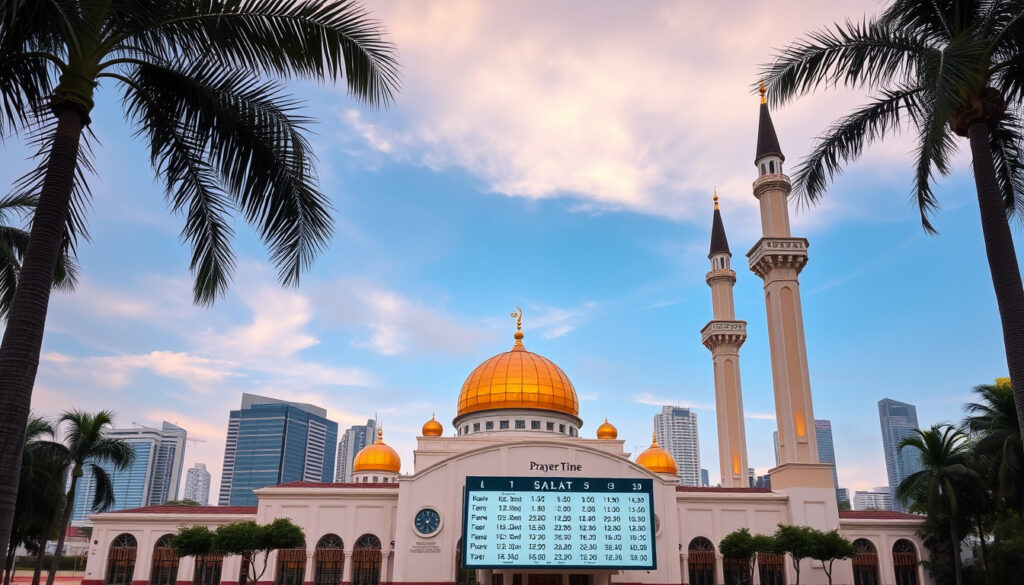
Salat Time in Singapore: Today’s MUIS Prayer Schedule
If you’re a Muslim in Singapore — whether you’ve lived here all your life or just arrived — you already know that prayer times aren’t a suggestion. They’re the rhythm of the day. What many people don’t realize is that there’s a single official authority setting those times for all of Singapore, and that same data flows through every app on your phone. That connection is what this guide is built around.
Subuh: 5:37am · Zohor: 1:03pm · Asar: 4:23pm · Maghrib: 7:07pm · Isha: 8:30pm
Quick snapshot
- MUIS publishes daily Subuh, Zohor, Asar, Maghrib, and Isyak times (MUIS)
- The 2025 CSV dataset on data.gov.sg covers all 365 days with 6 prayer times each (data.gov.sg)
- Apps like MuslimSG and prayertime.sg pull directly from MUIS data (Apple App Store)
- Exact 2026 CSV dataset hasn’t been published yet on data.gov.sg
- Some third-party apps don’t explicitly state MUIS as their source
- Specific Ramadan 2026 Imsakiah minute-by-minute times require PDF download
- 2025 dataset published and last updated 12 Feb 2025 (data.gov.sg)
- MUIS Islamic calendar page updated with 2026 PDF on 10 February 2026 (MUIS)
- Sample times available for 30 April 2026 on MUIS site (data.gov.sg)
- 2026 PDF timetable already downloadable from MUIS (572 KB)
- Ramadan 2026/1447H Imsakiah times available on Islamic calendar page
- ICS calendar subscriptions can auto-update monthly from official feeds
Six entities, 365 days a year, one official source — that’s the basic structure of Singapore’s prayer time ecosystem.
Key facts table
The table below captures the verified reference data sourced from MUIS and data.gov.sg for quick lookup.
| Label | Value |
|---|---|
| Authority | MUIS (Majlis Ugama Islam Singapura) |
| Subuh Time | 5:37am |
| Zohor Time | 1:03pm |
| Asar Time | 4:23pm |
| Maghrib Time | 7:07pm |
| Isha Time | 8:30pm |
| 2026 PDF Size | 572 KB |
| 2025 Dataset Last Updated | 12 Feb 2025 |
Prayer Time Singapore MUIS
Current MUIS timings
The Islamic Religious Council of Singapore (MUIS) sets prayer times for the entire country. On 30 April 2026, MUIS listed Subuh at 5:37am, Syuruk at 6:57am, Zohor at 1:03pm, Asar at 4:23pm, and Maghrib at 7:07pm. For that same date, Isha would fall around 8:30pm, completing the five daily prayers. Singapore uses the GMT+8 timezone for all calculations, and these times apply uniformly across the island — no regional variations, no zoning adjustments.
Those numbers shift daily, which is why MUIS maintains a full calendar rather than publishing static times. The 2025 dataset alone contains 365 rows of data, one row per day, with six columns covering Subuh, Syuruk, Zohor, Asar, Maghrib, and Isyak. The dataset was last updated on 12 February 2025 on data.gov.sg, making it the most granular public record available for that year.
How MUIS calculates times
MUIS uses astronomical calculation methods approved by Islamic scholars in Singapore. The times account for Singapore’s precise geographic coordinates (approximately 1.35°N latitude, 103.82°E longitude) and follow the Shafi’i methodology for Asar timing. Because Singapore sits close to the equator, seasonal variation in prayer times is less dramatic than in higher latitudes — Subuh stays between roughly 5:30am and 6:00am year-round, and Maghrib between roughly 7:00pm and 7:30pm.
Syuruk represents the time when sufficient light appears after Subuh to allow morning activities to resume — it’s not a prayer, but a practical cutoff that MUIS publishes for the community’s convenience.
The implication: Singapore’s proximity to the equator creates unusually stable prayer times compared to higher-latitude regions, making the official MUIS timetable reliable year-round with minimal seasonal adjustment.
When you see prayer times on any app or website, the question to ask is whether they trace back to MUIS. If they don’t, you may be following times calculated differently — with different coordinates, different calculation methods, or different Asar conventions.
Singapore Prayer Time 2026
Availability of 2026 schedules
If you’re planning ahead, the good news is that MUIS already has a 2026 prayer timetable available. The Islamic calendar page was updated on 10 February 2026 with a downloadable PDF (572 KB) containing full-year times. This PDF includes all six prayer marks — Subuh, Syuruk, Zohor, Asar, Maghrib, and Isyak — along with key Islamic dates for 1447H/2026.
The 2026 PDF also covers Ramadan 2026/1447H Imsakiah times, which is the countdown-to-fasting period that many Muslims track closely. Ramadan dates shift roughly 11 days earlier each year relative to the Gregorian calendar, so 2026’s Ramadan falls in February-March.
Sources for future times
Beyond the PDF, the most reliable way to access 2026 times is through official MUIS channels: the muis.gov.sg website directly, the MuslimSG app (iOS), or by subscribing to the MUIS ICS calendar feed. ICS subscriptions auto-update monthly and eliminate the need to manually check or download new files each month.
The one gap in the current record: the 2026 CSV dataset has not yet been published on data.gov.sg. The 2025 CSV is available there with 365 rows, but if you want machine-readable 2026 data, the MUIS PDF is your primary option until an official dataset appears.
The pattern: official data publishing on data.gov.sg lags behind the PDF release on muis.gov.sg by several weeks, giving the PDF a window as the only structured 2026 option for the near term.
Singapore Prayer Time App
Top apps for Singapore times
Several apps reliably use MUIS data as their foundation. The MuslimSG app (available on iOS) provides MUIS prayer times, Azan notifications, a Qiblah compass (Singapore only), Quran access, and mosque/halal locators. The app requires no setup — it works out of the box with MUIS times loaded by default.
The prayertime.sg app covers both Singapore and Malaysia, offers free prayer time reference, notifications, and an Islamic calendar. On Google Play, it ranks as a Top 3 Utility in Singapore, which reflects both its local relevance and steady user adoption. It also includes a Qibla compass functional worldwide.
The Singapore Prayer Times app (available through soft112.com) uses MUIS timings directly, offers Adhan notifications, works offline, and lets users switch between Shafi’i and Hanafi Asar calculation methods — a feature useful for the community’s diversity of madhab practice.
Muslim Pro features
Muslim Pro is widely known globally and shows prayer times aligned with MUIS for Singapore: Fajar 5:37, Dhuhur 13:03, Asr 16:23, Maghrib 19:07. The app also offers Quran access, Mecca calendar integration, and community features. However, it’s worth verifying that Muslim Pro explicitly traces its Singapore data to MUIS rather than using a generic calculation.
For Windows users, the Singapore Prayer Guide app delivers MUIS times via live tiles and lock screen support, ensuring you see the next prayer time without unlocking your device. Third-party apps like SalatKu use location-based calculations but don’t explicitly tie to MUIS, which introduces a small risk of minor timing discrepancies.
The catch: verification matters more than brand recognition. An established app with generic calculation versus a lesser-known app citing MUIS directly — the latter usually wins for accuracy in Singapore.
Not all apps that claim to show “Singapore prayer times” source their data from MUIS. Some use generic global calculation methods that may differ by a few minutes. For mosque attendance or community prayers, a few minutes’ difference matters — stick to MUIS-verified sources.
Prayer Time Singapore PDF
Downloadable PDF schedules
If you prefer a printed timetable for your home, office, or community center, PDFs are available from multiple sources. MUIS publishes the official yearly timetable as a PDF — the 2026 version is 572 KB on the Islamic calendar page. MusollahsSG.com also mirrors a 2025 PDF (585 KB) that was retrieved directly from MUIS.
The official MUIS PDF includes all six daily marks, key Islamic dates, and the Ramadan schedule. Printing it gives you a permanent reference that doesn’t require a phone or internet connection.
2026 PDF options
To download the 2026 MUIS PDF, visit the Islamic calendar page on muis.gov.sg. The page also includes Imsakiah times for Ramadan 2026, making it the most complete single document for the year. If you want the 2025 version for reference or historical comparison, the data.gov.sg CSV provides a structured alternative that’s easy to search or import into a spreadsheet.
Hisar Travel also publishes guides for syncing MUIS times with Google Calendar, iPhone, and Outlook via ICS feeds from muis.gov.sg or muslim.sg/prayer-times. This approach means you always have the latest times in your existing calendar app without downloading files manually.
What this means: printed PDFs remain relevant for offline access, while calendar integration suits those who live digitally — both paths start at the same MUIS source.
Isyak Time Today Singapore
Current Isyak timing
Isyak (Isha) is the fifth and final daily prayer, and its timing depends on when Maghrib (sunset) concludes plus a waiting period. For the sample date of 30 April 2026, with Maghrib at 7:07pm, Isyak would typically fall around 8:30pm. IslamicFinder adjusts this slightly based on its own calculation method, showing Isha around 7:07pm adjusted — but for MUIS-compliant times, the full waiting period is observed.
The exact Isyak minute varies day-to-day, which is why the PDF and app displays show it as a specific time rather than a formula. Checking the MUIS site or a verified app will always give you the accurate same-day value.
Variations across sources
Because Isyak depends on twilight calculations that vary slightly between methods, you may see different times reported across apps. MUIS and MUIS-derived apps (MuslimSG, prayertime.sg) will show the same Isyak time. Apps that use alternative astronomical calculations may show times a few minutes earlier or later.
For community prayers (like terawih during Ramadan), consistency with the mosque’s announced times matters. Most mosques in Singapore follow MUIS timings, so downloading the PDF or checking MuslimSG keeps you aligned with the local congregation.
The implication: Isyak is the prayer most susceptible to cross-app variance due to twilight threshold differences — always confirm against MUIS before Ramadan terawih.
How to Check Prayer Times in Singapore
Here’s the most direct path to accurate, up-to-date MUIS prayer times, whether you prefer an app, a PDF, or a calendar integration.
Step 1: Choose your preferred format
- App: Download MuslimSG (iOS) or prayertime.sg (Android) for automatic daily updates and notifications
- PDF: Download the 2026 timetable from muis.gov.sg/resources/islamic-calendar/ for a printed reference
- Calendar: Subscribe to the MUIS ICS feed at muis.gov.sg or muslim.sg/prayer-times to sync times to Google Calendar, iPhone, or Outlook
Step 2: Verify the source traces to MUIS
- Check the app description or settings for “MUIS” or “Majlis Ugama Islam Singapura”
- For PDFs, confirm the download is from muis.gov.sg or a verified community site like musollahsg.com
- Avoid third-party links shared on social media that redirect to non-MUIS sites — they may carry timezone errors or outdated data
Step 3: Set your notification preferences
- Most apps allow you to set alerts for each prayer — 10 or 15 minutes before is common
- If you’re using a Windows device, enable live tiles in the Singapore Prayer Guide app
- For calendar users, monthly ICS updates keep your events current without manual renewal
Step 4: Confirm before Ramadan
- Ramadan brings adjusted Imsakiah times — the MUIS PDF includes these alongside regular schedule entries
- If you’re following a third-party app, check whether it explicitly pulls the Ramadan update from MUIS
- The MuslimSG app typically updates Ramadan times automatically when MUIS publishes them
Upsides
- MUIS provides one standardized national schedule — no guesswork across mosques
- Multiple formats available: app, PDF, and calendar integration
- Free official resources from MUIS and government data portals
- 2026 timetable already published ahead of the year
Downsides
- 2026 CSV dataset not yet available on data.gov.sg — PDF is the main structured option
- Some third-party apps don’t explicitly credit MUIS, risking calculation mismatches
- Older integration guides (e.g., afriza.co.cc) are outdated and should be avoided
“In Singapore, the official prayer times are set and published by MUIS.”
— Hisar Travel, Calendar Integration Guide
“Prayer timings are based on ‘MUIS – Majlis Ugama Islam Singapura (Islamic Religious Council of Singapore)’.”
— Singapore Prayer Times App, App Description
For Singapore Muslims, the official prayer time system is remarkably straightforward: one authority, multiple access points, and data that’s already been published well in advance of the year it covers. The main trade-off is navigating the ecosystem of apps and PDFs to confirm you’re actually using MUIS-sourced times — especially during Ramadan when timing precision matters for imsak and terawih.
Related reading: Best halal biryani in Singapore · ITE school holiday dates Singapore
play.google.com, singapore-prayer-times.soft112.com, musollahsg.com, hisartravel.sg, apps.microsoft.com
Singapore Muslims often cross-reference Singapore Signals MUIS schedule with apps like Muslim Pro to confirm precise times such as Zohor at 1:03pm and Asar at 4:23pm.
Frequently asked questions
What are the five daily prayer times in Singapore?
The five prayers are Subuh (dawn), Zohor (midday), Asar (afternoon), Maghrib (sunset), and Isyak (night). Each has a specific MUIS-calculated time that shifts slightly day to day throughout the year.
How often do prayer times update in Singapore?
MUIS publishes a full-year timetable at once, so the same schedule covers all 365 days. During Ramadan, Imsakiah times are published separately on the Islamic calendar page. Apps and ICS feeds may receive monthly updates.
Is Muslim Pro accurate for Singapore?
Muslim Pro aligns with MUIS data for Singapore, showing Subuh around 5:37am and Maghrib around 7:07pm. However, always verify in the app settings that Singapore is selected as the location and that MUIS is listed as the calculation source.
Where is the official prayer time source?
The official source is MUIS (Majlis Ugama Islam Singapura) at muis.gov.sg. The MuslimSG app and prayertime.sg app both use MUIS data directly. The CSV dataset is on data.gov.sg, and PDFs are available on the MUIS Islamic calendar page.
Do prayer times vary by calculation method?
Yes — different calculation methods can produce slightly different times, especially for Asar (Shafi’i vs Hanafi) and Isyak (twilight thresholds). MUIS uses Shafi’i methodology. Apps that allow madhab switching let you toggle between methods for Asar only.
What is Syuruk time?
Syuruk is the civil sunrise time — when there’s enough natural light after Subuh for normal activities. It’s not a prayer but a practical marker that MUIS publishes so the community knows when morning restrictions end.
More related posts
 SP Services Open Account: How to Set Up Utilities in Singapore
 Kwan Yong Construction Pte Ltd – Company Overview and Key Facts
 Hari Raya Haji 2026: Date, Public Holiday & Significance
 How Many Hours in a Year – Leap and Non-Leap Counts
 What Is a PDF Reader? A Guide for All Devices
 7 Warning Signs of Dengue Fever: Spot Early – CDC Guide
 Billie Eilish Mirror Strap Photo: Controversy Explained
 T-Bill Auction Results Today – Latest Status and Analysis
