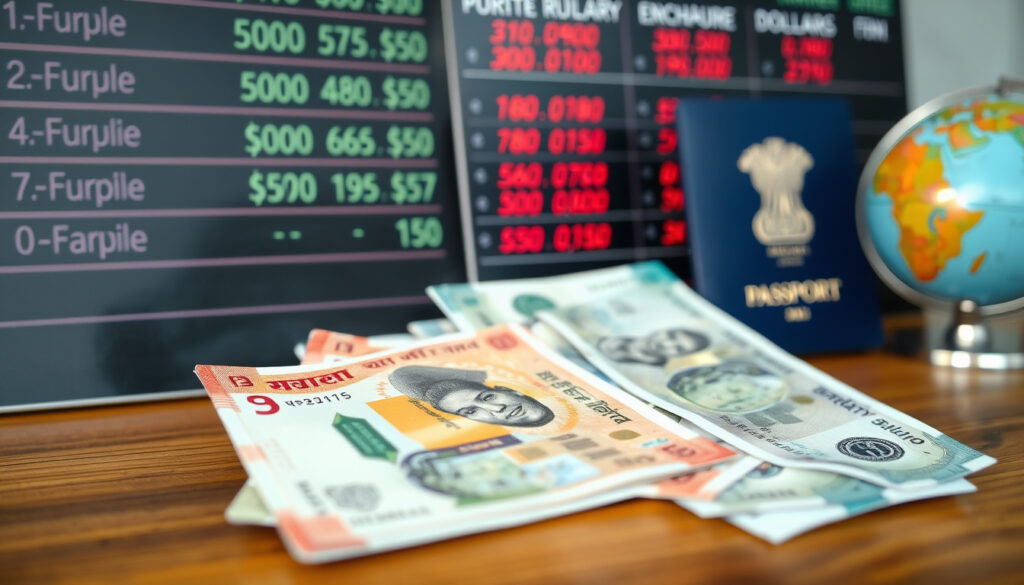
India Rupee to SGD: Live Rate, Conversion & Travel Guide
Anyone planning a trip from India to Singapore has probably spent a few minutes staring at a currency converter, trying to figure out how many Singapore dollars their rupees will stretch to. The answer isn’t as simple as plugging in a number — between mid-market rates, bank markups, and the choice between cash and cards, the actual amount you get can vary significantly.
1 INR to SGD (mid-market rate, as of data collection): S$0.0135 ·
1 SGD to INR (mid-market rate, as of data collection): ₹73.85 ·
Popular conversion: 10,000 INR to SGD: S$135.00 ·
Typical currency exchange markup (retail banks): 2-5% above mid-market rate
Quick snapshot
- Mid-market rate: 1 INR = 0.0135 SGD, 1 SGD = 73.85 INR (XE (currency data provider))
- Retail banks add 2-5% markup on exchange (Expatica (expat finance guide))
- Singapore is cash-lite; cards and mobile pay widely accepted (XE (currency data provider))
- Indian debit/credit cards incur 2-3.5% foreign transaction fees (XE (currency data provider))
- Exact fees for specific Indian bank cards in Singapore vary; check with your issuing bank
- Future exchange rate fluctuations cannot be predicted
- The exact markup applied by individual exchange counters may vary
- The availability of fee-free cards depends on the card issuer and may change
- No significant timeline events — rates fluctuate daily
- Indian travellers should lock in rates early or use fee-free digital options
Five key numbers sum up the conversion landscape for Indian travellers heading to Singapore:
| Metric | Value | Source |
|---|---|---|
| 1 SGD = (mid-market rate) | ₹73.85 | XE (currency data provider) |
| 1 INR = (mid-market rate) | S$0.0135 | BookMyForex (India forex platform) |
| Common retail markup | 2-5% above mid-market rate | Expatica (expat finance guide) |
| Popular Indian amount to convert (1 lakh INR) | ≈ S$1,350 | Wise (money transfer service) |
| Cash recommended for a week in Singapore | S$100-200 (approx. ₹7,400-14,800) | General travel estimates |
How much is 1 SGD in INR?
Live mid-market exchange rate for SGD to INR
- As of data collection, the mid-market rate shows 1 SGD = approximately 73.85 INR, according to XE (real-time currency conversion tool).
- This is the rate you see on Google or financial portals — it’s the wholesale rate used between banks, not the rate you’ll get at a counter.
Why the rate you get at a bank or exchange counter is different
- Retail banks and currency exchanges add a markup of 2–5% on top of the mid-market rate. Expatica (expat finance resource) notes that banks also levy cable charges (flat S$20) and FX margins that reduce the amount you receive.
- For example, converting SGD 1,000 at a bank might cost you closer to ₹72,000 after fees, instead of the mid-market ₹73,850.
For Indian travellers sending money home or receiving SGD, the bank’s 2-5% markup on a ₹73,850 transfer means losing ₹1,500 to ₹3,700 before the money moves — simply for the privilege of using a traditional wire.
The pattern is clear: the mid-market rate is a reference point, not a price you can actually transact at. The markup is where the real cost hides.
How much is 1 INR in SGD?
Live mid-market exchange rate for INR to SGD
- 1 INR equals approximately S$0.0135 at the mid-market rate, as reported by BookMyForex (India’s currency exchange aggregator).
- This inverse rate means every 100 INR is worth about S$1.35; 1,000 INR gives you S$13.50.
Converting large amounts: 1 lakh and 1 crore rupees to SGD
- 1 lakh INR (₹100,000) converts to roughly S$1,350 at mid-market.
- 1 crore INR (₹10,000,000) converts to roughly S$135,000.
- At retail counters, you’ll lose 2–5% of those amounts — that’s S$27–67 on a lakh and S$2,700–6,750 on a crore.
High-value transfers attract the biggest absolute fees. A difference of 2% on ₹1 crore is ₹2 lakh — enough to cover a return flight to Singapore.
What this means: the gap between mid-market and retail widens fast the more you convert. For larger sums, a fee-conscious service like Wise or a dedicated forex transfer beats bank wires by a wide margin.
Should I carry cash in Singapore?
Cash usage in Singapore: a cash-lite society
- Singapore runs largely cash-lite. Credit and debit cards are accepted at most restaurants, hotels, and retail stores. Mobile payments like PayNow, GrabPay, and Apple Pay are ubiquitous.
- However, cash remains essential at hawker centres (food courts), some taxis, and small independent shops that may not accept cards.
Cards and digital payments: what is widely accepted
- Visa, Mastercard, and UnionPay are accepted nearly everywhere. American Express has narrower coverage.
- Indian-issued cards carry foreign transaction fees of 2–3.5% per swipe, as a percentage of the amount charged. Check with your bank — some premium cards waive these fees.
Carrying some cash for hawker centers and taxis
- Recommend bringing S$100–200 in cash (₹7,400–14,800) for small purchases. You can withdraw SGD from ATMs in Singapore, but your Indian bank will charge a foreign ATM fee plus the transaction fee.
- Alternatively, exchange a small amount in India before departure to get a known rate.
The implication: you don’t need much cash, but you need some. Relying entirely on a card leaves you stuck at a hawker stall with no backup.
What is the best currency to take to Singapore for Indian travelers?
Exchanging INR to SGD in India vs. Singapore
- Exchanging INR to SGD in India is often cheaper. BookMyForex aggregates rates from authorised dealers and lets you compare markups. In Singapore, money changers in Little India may offer competitive rates, but you’re exposed to fluctuating rates and limited options.
- Indian banks and authorised forex dealers typically offer better spreads than Singapore airport counters, which charge premiums for convenience.
Using an international debit/credit card in Singapore
- Cards from Indian banks (Visa/Mastercard) incur 2–3.5% foreign transaction fees. Some premium cards (e.g., Axis Burgundy, HDFC Regalia) waive these — verify before your trip.
- For ATM withdrawals, expect a flat fee (often ₹100–200) plus the currency conversion charge.
Prepaid travel cards: a good option?
- Prepaid forex cards let you lock in a rate before departure. They work like debit cards and are accepted at merchants and ATMs.
- Downsides: loading and reloading fees (typically 1–2%), inactivity charges, and the risk of leftover foreign currency after the trip.
Why this matters: for Indian travellers, the cheapest solution is usually a combination — exchange a small amount of cash in India for immediate expenses, use a fee-free international card for larger purchases, and consider a prepaid card if you want rate certainty.
How much does a 7-day trip to Singapore cost?
Sample budget breakdown for a mid-range Indian traveler
- Mid-range budget for 7 days: S$1,200 to S$2,500 (approx. ₹88,600 to ₹1,84,600).
- Major expenses break down as follows:
Four items, one pattern: accommodation and food dominate, while transport is surprisingly low thanks to the MRT.
| Expense category | Cost per day (SGD) | Cost per day (INR approx.) | Notes |
|---|---|---|---|
| Hotel (mid-range, 3-star) | S$70–150 | ₹5,170–11,080 | Budget hotels like Fragrance or ibis; Airbnb alternatives |
| Food | S$20–40 | ₹1,480–2,950 | Hawker meals S$4–8; restaurant meals S$15–30 |
| Transport | S$10–20 | ₹740–1,480 | MRT day pass ~S$10; occasional rideshare |
| Attractions/activities | S$20–40 | ₹1,480–2,950 | Marina Bay Sands, Gardens by the Bay, Sentosa |
The takeaway: a 7-day trip costs roughly S$1,700 on average — about ₹1.25 lakh. Budget-conscious travellers can cut that to S$1,200 by choosing hostels and hawker meals; luxury goes beyond S$2,500 easily.
Comparing your options: cash, card, and prepaid
Three methods, one trade-off: convenience costs more, but the savings require planning.
| Method | Rate you get | Fees | Best for | Downsides |
|---|---|---|---|---|
| Cash exchanged in India (bank/forex dealer) | Mid-market minus 2-5% markup | No additional fees | Immediate spending, small amounts | Locked rate; leftover cash after trip |
| Cash exchanged in Singapore (Little India money changer) | Competitive – may be closer to mid-market | Commission sometimes waived | If you forgot to exchange in India | Inconvenient; rates vary daily |
| Indian debit/credit card (Visa/Mastercard) | Mid-market + 2-3.5% foreign transaction fee | Per transaction fee + ATM fee | Large purchases, online bookings | Fees add up; not accepted at hawkers |
| Prepaid forex card (e.g., BookMyForex, Thomas Cook) | Locked rate at load time | 1-2% loading fee; reload fee; inactivity charge | Rate certainty, multiple currencies | Underused balance; fees for reload |
| Digital wallet / fintech (Wise, Revolut) | Mid-market rate; exchange during market hours | Low or zero (depending on plan), out-of-hours 1% fee | Savvy travellers, larger transfers | Card issuance fee; limited ATMs for cash |
The pattern: every method carries a hidden cost. The best choice depends on whether you prioritise convenience, rate certainty, or fee minimisation.
Pros and cons of each method
Upsides
- Cash in hand from India – no card acceptance worries
- Cards and mobile pay – widely accepted, no need to carry large sums
- Prepaid cards – lock in rate, protect against currency fluctuations
- Fintech (Wise/Revolut) – near mid-market rates, transparent fees
Downsides
- Cash from India – markups of 2-5%; residual currency
- Indian cards – 2-3.5% foreign transaction fees
- Prepaid cards – loading/reloading fees; unspent balance
- Fintech – may require a physical card; out-of-hours fees
The trade-off: no single method is cheapest for every scenario. Plan a mix: cash for hawkers, a fee-free card for hotels and shopping, and a digital service for emergency top-ups.
Step-by-step: how to get the best INR to SGD rate
- Check the mid-market rate – Use XE or Wise (real-time converter) to know the baseline.
- Compare exchange markups – Use BookMyForex (India forex rate aggregator) to see which Indian dealer offers the best rate.
- Decide on method – For amounts below ₹50,000, cash in India may be simplest. For larger amounts, consider a fintech transfer.
- Get a fee-free card – Apply for an Indian credit card that waives foreign transaction fees (e.g., Axis Burgundy, HDFC Regalia).
- Set a budget – Plan your daily SGD spending to avoid over-converting.
- Withdraw SGD from ATMs – If needed, use an ATM affiliated with a global network (e.g., HSBC, Citi) to minimise fees. Reject dynamic currency conversion (always choose SGD).
For Indian travellers, the choice and consequence are clear: a little upfront planning can save you thousands of rupees — on a ₹1 lakh trip, a 3% markup costs you ₹3,000, which is two nights in a budget hotel.
singsaver.com.sg, razorpay.com, revolut.com, linkedin.com, dbs.com.sg, rbi.org.in, mycurrencytransfer.com, uob.com.sg
Frequently asked questions
Can I use Indian rupees directly in Singapore?
No, Indian rupees are not accepted as legal tender in Singapore. You must convert to Singapore dollars.
What is the 60-90 rule in Singapore?
The 60-90 rule refers to the regulation that foreign visitors can stay in Singapore for up to 60 or 90 days without a visa (depending on nationality). It is not related to currency conversion.
Is it better to exchange currency in India or Singapore?
Generally, exchanging in India gives you a more predictable rate and avoids Singapore’s airport markup. However, money changers in Singapore’s Little India can offer competitive rates.
How much is 5000 Indian rupees in Singapore dollars?
At the mid-market rate (1 INR = 0.0135 SGD), 5,000 INR equals approximately S$67.50.
What is the cheapest way to send money from India to Singapore?
Digital services like Wise or Revolut offer near mid-market rates with low fees, typically cheaper than bank wires. Check RemitFinder (transfer cost comparison) for current options.
Do I need to declare currency when traveling from India to Singapore?
Yes. You must declare cash (or equivalent instruments) over S$20,000 when entering Singapore. India also requires declaration for sums above ₹25,000 in foreign currency.
Related reading
More related posts
 Bukit Timah Family Clinic: Services, Costs & Location
 Re-Entry Permit Singapore: Apply, Renew, Transfer 2025 Revisions
 3 Good Guys Movie: Release Date, Cast, Trailer (2026)
 Blood in Urine in Women: Causes, What It Means, and When to Worry
 How to Cure Mouth Ulcers Fast Naturally
 The Courage to Be Disliked: Main Point, Theory, and Book Review
 Climate Voucher 2025 Redeem: Claim $400 in Singapore
 20000 AED to SGD: Convert 20,000 Dirhams to Singapore Dollars
