Right Hand Grip Rule: Definition, How to Use, and Examples
If you’ve ever wrapped your right hand around a wire and tried to picture invisible magnetic fields, you’ve used the right‑hand grip rule. It’s a simple mnemonic that translates a current’s direction into the orientation of the field lines around it.
First documented use: 19th century (Ampère) ·
Primary application: Electromagnetism direction ·
Variants: 3 (grip, Fleming’s, curl) ·
Educational level: High school to university
Quick snapshot
- Thumb points in direction of conventional current (Alloprof (educational resource))
- Fingers curl in direction of magnetic field (Arbor Scientific (science supply educator))
- Exact origin of the hand mnemonic is debated (Wikipedia (encyclopedic reference))
- Some textbooks use left‑hand rule for electron flow instead of conventional current (Wikipedia (encyclopedic reference))
- Right‑hand grip rule is a mnemonic for magnetic field direction (Wikipedia (encyclopedic reference)) — confidence in precise historical origins is moderate
- 1820s: Ampère describes relationship between current and magnetic field (Wikipedia (encyclopedic reference))
- Early 1900s: Fleming formalises hand rules for motors and generators (Wikipedia (encyclopedic reference))
- Explore the cross‑product form of the rule for three‑dimensional vector calculations
- Apply the rule to more complex coil geometries in motor design
The four facts below capture the essential identifiers of the right‑hand grip rule and its historical context.
| Label | Value |
|---|---|
| Inventor | André‑Marie Ampère (concept), John Ambrose Fleming (hand mnemonic) |
| Year | 1820s (Ampère), early 1900s (Fleming) |
| Application | Determining magnetic field direction around current |
| Variants | Right‑hand grip rule, Fleming’s right‑hand rule, curl rule |
What is the right‑hand grip rule?
Origin and history
- The relationship between electric current and magnetic field was first described by André‑Marie Ampère in the 1820s.
- John Ambrose Fleming later formalised a set of hand mnemonics in the early 1900s to help engineers remember force, field, and current directions in motors and generators.
- The rule is a convention, not a physical law – it provides a consistent way to apply the cross‑product direction.
Core principle
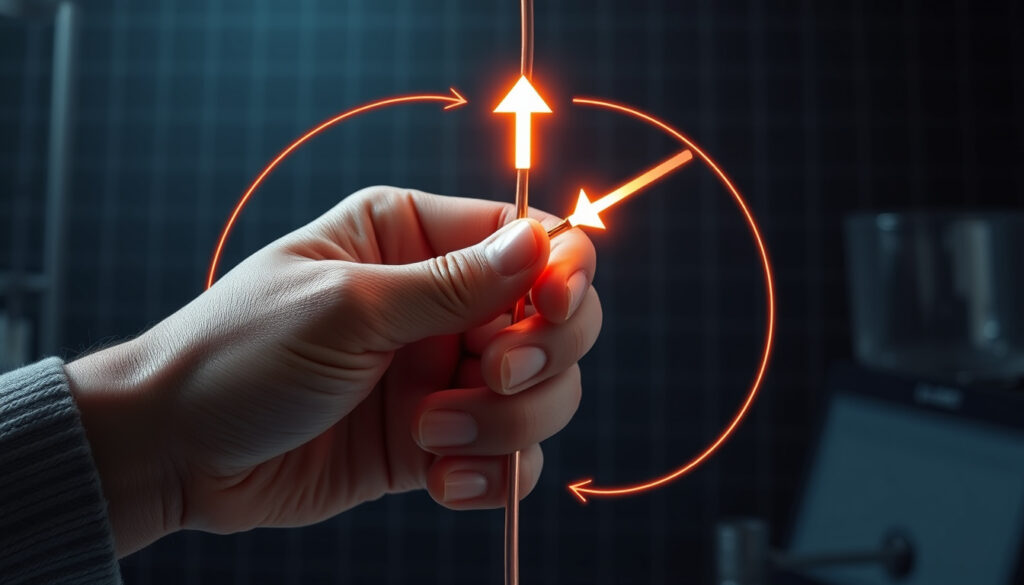
- The right‑hand grip rule states: if you grip a current‑carrying wire with your right hand so your thumb points in the direction of conventional current (positive to negative), your fingers curl in the direction of the magnetic field lines around the wire.
- This holds for any long straight conductor.
- For a solenoid (a coil of wire), the same grip rule identifies the north pole: fingers follow the current, and the thumb points to the north end.
The pattern: One simple hand gesture encodes three vectors – current, field, and (for a solenoid) polarity. That’s why it’s taught in every introductory physics course.
How do you use the right‑hand grip rule?
Step‑by‑step for a straight wire
- Hold the wire with your right hand, palm facing the wire.
- Point your thumb in the direction of conventional current flow (from positive terminal to negative terminal).
- Your fingers naturally curl around the wire. That curl shows the direction of the magnetic field lines – circulating counter‑clockwise when viewed from the direction of current (Excel@Physics (physics tutorial site)).
- The magnetic field is strongest close to the wire and weakens with distance.
A student who mixes up conventional current and electron flow will get the opposite field direction. Using the left‑hand for electron flow fixes this, but most curricula stick with the right‑hand convention.
Step‑by‑step for a solenoid
- Wrap your right hand around the solenoid so your fingers curl in the same direction as the conventional current flows through the coils.
- Your thumb now points to the north pole of the solenoid.
- Inside the solenoid, the magnetic field lines run from south to north (i.e., from the opposite end to your thumb).
- Outside the solenoid, the field lines exit the north pole and enter the south pole.
The catch: The solenoid rule only works for conventional current direction. If you’re dealing with electron flow, you’d need the left‑hand grip rule – a common source of confusion in exams.
What is the right‑hand grip rule on a solenoid?
Determining polarity
- With fingers wrapped along the current path, the thumb identifies the north geographic pole of the electromagnet.
- Increasing the number of turns in the solenoid strengthens the magnetic field proportionally.
- The magnetic field inside a long solenoid is nearly uniform and parallel to the axis.
Field lines inside and outside
- Inside the solenoid: field lines are straight and run from the south pole to the north pole.
- Outside: field lines loop from north back to south, similar to a bar magnet.
- A solenoid’s field direction depends entirely on the direction of current in the coil; reversing the current flips the poles.
A tight‑wound solenoid gives a strong uniform field ideal for relays and actuators, but the rule only works if you consistently track current direction – any winding reversal flips the polarity.
The pattern: Solenoid polarity depends entirely on the direction of current flow through the coil, making the right‑hand grip rule an essential tool for predicting magnetic behavior in electromagnet design.
Who invented the right‑hand grip rule?
André‑Marie Ampère’s contribution
- Ampère discovered the mathematical relationship between electric current and the magnetic force in the 1820s, laying the foundation for electrodynamics.
- He experimentally showed that parallel currents attract and opposite currents repel, which hinted at the circular magnetic field pattern.
- Ampère did not formulate a hand rule; that came later as a teaching aid.
Later formalisation by Fleming
- John Ambrose Fleming, an English electrical engineer, published the hand rules in his 1902 book “The Alternate Current Transformer” to help engineers remember the direction of induced currents in generators.
- Fleming’s right‑hand rule specifically applies to generators: thumb = motion, forefinger = field, middle finger = current.
- The right‑hand grip rule for wires and solenoids is a close relative but was codified independently in textbooks.
Is Fleming’s right‑hand rule still relevant?
Comparison with right‑hand grip rule
Both rules use the right hand but serve different physical contexts. The table below highlights the key differences.
| Aspect | Right‑hand grip rule | Fleming’s right‑hand rule |
|---|---|---|
| Purpose | Determine magnetic field direction around current | Determine induced current direction in a generator |
| Application | Straight wires, solenoids, loops | Moving conductors in magnetic fields |
| Fingers | Fingers curl → magnetic field direction | Forefinger = field, middle finger = current |
| Thumb | Thumb = conventional current (or north pole for solenoid) | Thumb = motion of conductor |
| Physical quantity | Current → field | Motion + field → induced current |
| Still taught | Yes, in electromagnetics | Yes, in generator theory |
Modern applications
- Engineers still use Fleming’s right‑hand rule to analyse generator and alternator behaviour.
- The right‑hand grip rule remains essential for designing solenoids, inductors, and electric motors.
- Both rules are included in high school and university physics curricula worldwide.
The implication: Mastering both rules gives engineers and students a complete toolkit for analyzing electromagnetic systems, from simple wires to complex generators.
Quotes from educators
“Physicists use a hand mnemonic known as the right‑hand rule to help remember the direction of magnetic forces.” — Khan Academy (non‑profit educational platform)
“In mathematics and physics, the right‑hand rule is a convention and a mnemonic, utilized to define the orientation of axes in three‑dimensional space.” — Wikipedia (encyclopedic reference)
Summary
The right‑hand grip rule transforms an abstract vector relationship into a physical gesture anyone can learn. For a student tackling electromagnetism for the first time, the choice is clear: keep a ruler nearby and practice on both straight wires and solenoids until the field direction becomes instinctive. Without that foundation, later work on motors, generators, and induction will always feel like guesswork.
While the right hand grip rule determines magnetic field direction, the complementary Flemings left hand rule helps find the force direction on a current-carrying conductor.
Frequently asked questions
What is the difference between the right‑hand grip rule and the left‑hand grip rule?
The right‑hand grip rule uses conventional current direction (positive to negative); the left‑hand version is used for electron flow (negative to positive). Most curricula teach the right‑hand rule exclusively.
Can the right‑hand grip rule be used for electron flow?
Not directly – if you use the right hand with electron flow your thumb points opposite to the magnetic field. Use the left‑hand grip rule instead for electron flow.
Does the right‑hand grip rule work for AC current?
It works for instantaneous current direction. Since AC reverses direction periodically, the magnetic field direction also reverses each half‑cycle.
Why is the right‑hand rule called a mnemonic?
Because it helps you remember a direction without a formula. The hand position maps to the cross‑product relationship between current and field.
How is the right‑hand grip rule applied in electric motors?
In a motor, the rule helps determine the magnetic field direction produced by stator coils, which interacts with rotor currents to produce torque.
What is the curl right‑hand rule used for?
It’s another name for the right‑hand grip rule applied to a loop of wire: curl fingers along current, thumb gives the direction of the magnetic moment.
Is the right‑hand grip rule the same as Fleming’s right‑hand rule?
No. The grip rule finds magnetic field from current; Fleming’s rule finds induced current from motion in a field. They complement each other but apply to different scenarios.
Related reading
More related posts
 Man Dies on Board Cruise Ship: Recent Deaths and Safety Insights
 Why Is My Poop Green? Causes, Duration, When to Worry
 Air India Crash Survivor – Flight 1344 Escape Accounts
 SP Services Open Account: How to Set Up Utilities in Singapore
 Honor Magic 6 Pro Review: Is It Worth Buying? (2024)
 DJI Osmo Pocket 3 Singapore: Price, Stock, Worth It
 Yeon Jung-hoon – Age, Wife Han Ga-in, Dramas & 2024 Rumors
 Sony Reon Pocket Pro Review: Worth It? Price & Specs
