How to Measure Luggage Size – Step-by-Step Airline Guide
Getting stopped at the gate with an oversized bag is an expensive mistake. Airlines collected billions in baggage fees last year, much of it from travelers who misjudged their luggage dimensions by mere inches. Understanding how to measure luggage size correctly—accounting for every wheel, handle, and exterior zipper—can mean the difference between a smooth boarding process and an unexpected gate-check fee.
The standard method involves measuring the exterior dimensions from the farthest points of the bag, including all protrusions. Yet confusion persists about whether wheels count, how to calculate linear inches, and which tools provide accurate readings. This guide breaks down the precise techniques airlines use to verify bag sizes, ensuring your measurements match theirs before you leave for the airport.
Whether you are sizing a compact carry-on for a weekend trip or verifying checked baggage limits for international travel, the process remains consistent. A flexible tape measure, a flat surface, and attention to external details are all that stand between you and a hassle-free check-in.
How Do You Measure Luggage Size?
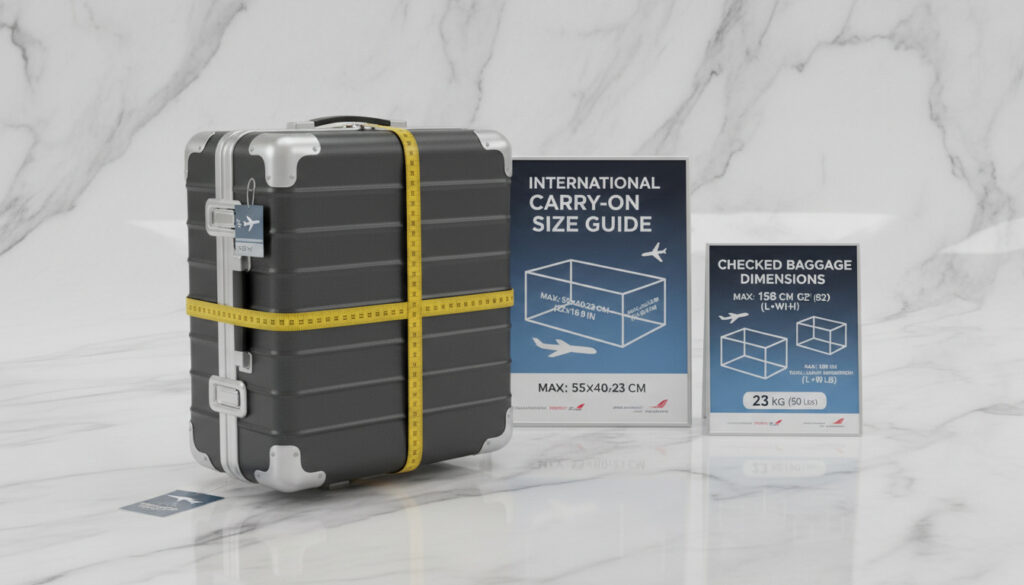
Precise measurement requires following a specific sequence. Place the suitcase on a flat, level surface with wheels touching the ground and the bag standing in its natural upright position. Using a retractable tape measure, record three dimensions: height from floor to the tallest point (including handles), width at the widest section (including side handles), and depth from the back wheels to the front-most edge.
For checked luggage, airlines use linear inches—the sum of height, width, and depth. A bag measuring 28 by 18 by 10 inches equals 56 linear inches, well within the standard 62-inch limit. Carry-on bags are typically judged by individual dimensions rather than linear totals, though the calculation method remains identical.
- Always measure from the farthest external points, never the bag body alone
- Linear inches equal height plus width plus depth
- Most US carriers accept 22″ × 14″ × 9″ for carry-on
- Checked luggage typically allows 62 linear inches maximum
- International flights often enforce smaller dimensions and weight limits
- Measure soft bags when compressed to avoid bulge errors
- Round up to the nearest inch to account for measurement variance
| Bag Category | Typical Dimensions | Linear Inches | Weight Limit |
|---|---|---|---|
| Carry-on (US Domestic) | 22″ × 14″ × 9″ | 45″ | None specified |
| Carry-on (International) | 21-22″ × 15″ × 9″ | 45-50″ | 15-26 lbs |
| Checked Standard | Varies | 62″ max | 50 lbs |
| Personal Item | 17″ × 13″ × 9″ | N/A | None specified |
| Southwest Carry-on | 24″ × 16″ × 10″ | 50″ | None specified |
| Hawaiian Airlines | 22″ × 14″ × 9″ | 45″ | 25 lbs |
Do Wheels and Handles Count in Luggage Measurements?
Yes. Airlines universally include wheels, handles, and any external hardware when measuring luggage. This policy represents the most frequent point of confusion among travelers, with many purchasing bags labeled “carry-on size” only to discover at the gate that external components push the bag over the limit.
The External Dimension Standard
Airlines measure the total space a bag occupies in the overhead bin or cargo hold, not merely the interior capacity. For spinner luggage, measure from the floor to the highest point of the retracted handle, and across the full width including the wheel housings. On two-wheeled rollers, the back posts and wheels often add two to three inches to the stated bag height.
Common Misconceptions
Retail packaging frequently lists the interior body dimensions or the suitcase frame without protrusions. A bag marketed as “22-inch carry-on” often measures 24 inches or more when wheels are included. Travelers Club notes that this discrepancy causes the majority of gate-check violations.
Airlines strictly enforce including wheels and handles in all measurements. A bag marketed as “22-inch carry-on” often exceeds 24 inches when wheels are included, triggering gate-check fees. Always measure from the floor to the top of the handle grip, and from the farthest point of one wheel to the farthest point of the opposite wheel for width.
How Do Airlines Measure Baggage Size?
Airlines employ metal sizers—rectangular frames—at check-in counters and gates to verify dimensions instantly. If your bag fits through the sizer without force, it passes. If wheels or handles catch on the frame, agents require gate-checking regardless of what your tape measure indicated at home.
Understanding Linear Inches
Linear inches provide a single metric for irregularly shaped bags. Rather than enforcing strict height, width, and depth limits independently for checked luggage, carriers add the three measurements together. Global Rescue confirms that 62 linear inches represents the standard ceiling for checked bags across most carriers, though weight limits vary significantly.
US Domestic Carrier Variations
While most major US airlines standardize around 22 by 14 by 9 inches for carry-on, exceptions exist. Southwest permits bags up to 24 by 16 by 10 inches, while Spirit and Frontier allow larger linear totals but charge for carry-on items. American Airlines and Delta maintain the 22-by-14-by-9 standard without weight restrictions, whereas Hawaiian limits carry-on to 25 pounds.
International Size Restrictions
International carriers typically enforce stricter standards. Lufthansa limits bags to 21.7 by 15.7 by 9 inches with a 17.6-pound weight cap, while Qatar Airways restricts dimensions to 20 by 15 by 10 inches. TravelPro maintains that travelers flying multiple international carriers should purchase 21-inch “international” size bags to ensure compliance across codeshare partners.
Tools and Tips for Accurate Luggage Measurement
Accurate measurement requires proper tools and technique. Avoid using soft fabric tape measures that stretch, or yardsticks that cannot wrap around curved corners. Instead, use a rigid retractable tape measure for straight edges and a flexible tailor’s tape for soft-sided bags with rounded profiles.
Essential Tools
A 25-foot retractable tape measure provides sufficient length for large checked bags. For precision on wheel assemblies and telescoping handles, digital calipers can verify exact protrusion distances. When measuring at home, place the bag against a wall to ensure it stands perfectly upright, eliminating the tilt that can reduce height readings by an inch or more.
Use a flexible tailor’s tape measure rather than a rigid ruler. Soft-sided bags curve at corners, and rigid tools often miss the farthest points. For precision on handles and wheel assemblies, digital calipers can verify exact protrusion distances, though a standard retractable tape measure suffices for most travelers.
Common Mistakes to Avoid
The most frequent error involves measuring only the fabric body while ignoring external pockets, wheels, and handles. NerdWallet reports that expansion zippers cause additional violations—bags measured when empty often grow by two inches when fully packed. Always measure with the bag packed as it will be during travel.
Measure your bag twice: once empty and once fully packed with expansion zippers engaged. Airlines measure the bag as presented at the gate, not its collapsed state. If your bag features external pockets, ensure they are filled as they would be during travel, as overstuffed pockets often push dimensions over the limit.
How Luggage Standards Have Evolved
Baggage size enforcement has tightened considerably over the past two decades. Following security enhancements post-2001, airlines reduced carry-on allowances to maximize cabin space. Recent trends indicate further restriction: by 2026, industry analysts expect universal adoption of 22-by-14-by-9 as a hard ceiling rather than a guideline, with automated sizing gates replacing manual checks at major hubs.
- Early 2000s: Minimal enforcement; soft bags rarely measured
- 2010s: Introduction of metal sizers at gates; fee structures for oversized bags
- 2020s: Weight restrictions added by international carriers; stricter carry-on limits
- 2024-2026: Trend toward automated measurement systems and reduced overhead capacity
What Is Certain vs. What Varies
While measurement methodology remains consistent across the industry, enforcement and specific limits fluctuate by carrier and even by individual airport staff.
| Established Facts | Variable Factors |
|---|---|
| Wheels and handles always included | Strictness of gate enforcement |
| 62 linear inches standard for checked bags | Weight limits by carrier |
| Linear inches = H + W + D | Availability of sizers at regional airports |
| Soft bags measured at maximum bulge | International vs. domestic standards |
Why Accurate Measurement Matters
Oversized luggage incurs fees ranging from $65 for gate-checked carry-ons to several hundred dollars for overweight checked bags on international routes. Beyond cost, incorrectly sized bags create boarding delays and safety hazards—overstuffed overhead bins have caused injuries during turbulence. Ricardo Beverly Hills notes that travelers who verify dimensions before arrival avoid 90% of baggage-related travel stress.
For international travelers, size violations create additional complications. Some airports lack the facilities to process oversized bags at the gate, forcing passengers to return to check-in counters and risk missing flights. Accurate measurement serves as cheap insurance against these disruptions.
Official Airline Guidance
Major carriers provide specific language regarding measurement protocols. American Airlines states clearly that dimensions include “wheels and handles,” while Delta notes that bags must fit “with ease” in the sizer—forcing or angling the bag constitutes a failure.
“Carry-on bags shouldn’t exceed 22 x 14 x 9 inches (45 linear inches), including wheels and handles. Measure your bag carefully before arriving at the airport.”
— American Airlines Baggage Policy
Wayward Blog aggregates current policies across carriers, noting that even budget airlines have begun strictly enforcing previously ignored size limits as overhead space becomes premium real estate.
Key Takeaways for Measuring Luggage
Successful luggage measurement requires including every external component, using appropriate tools, and verifying against your specific carrier’s current policy. When in doubt, purchase 21-inch international-sized carry-ons and ensure checked bags remain under 62 linear inches and 50 pounds. For additional travel preparation resources, see our guide on SG to India Currency – Latest Rate and Converter to manage your travel budget effectively.
Frequently Asked Questions
What happens if my carry-on is one inch too big?
Most airlines require gate-checking, typically charging $65 or more. Some budget carriers charge higher fees at the gate than at check-in.
Can I use a soft measuring tape for luggage?
Yes, flexible tailor’s tapes work well for soft-sided bags, but ensure the tape doesn’t stretch. Rigid retractable tapes provide the most consistent readings for hard-shell cases.
How strict are airlines about luggage size?
Strictness varies by carrier, route, and how full the flight is. Major US carriers enforce limits consistently at busy hubs, while regional flights may be more lenient.
Do airlines measure every bag?
No. Oversized or bulky bags attract attention, while standard-looking roller bags often pass without measurement. However, full flights prompt stricter enforcement.
What is the best way to measure a duffel bag?
Pack it fully, then compress slightly while measuring the farthest points. Unlike hard cases, duffels expand when filled, so measure at maximum capacity.
Should I buy luggage with exact airline dimensions?
Purchase bags one inch smaller than maximum limits to account for manufacturing variance and overpacking. For home cooling solutions while preparing for travel, consider Ceiling Fan With Light Singapore – Best DC Models For HDB Flats.
More related posts
 Isyak Time Today in Singapore: Isha Prayer Schedule
 Sinners (2025) Showtimes: Tickets, Reviews & Where to Watch
 Hooker Valley Track Closure 2025: Status & Alternatives
 Brentford vs Manchester United: 4-0 Win, H2H & Transfer Battle
 Kwan Yong Construction Pte Ltd – Company Overview and Key Facts
 Singapore MRT Map: PDF Download, Latest Guide & Future
 King Size Bed Dimensions: Complete Guide (US, UK, Ireland)
 Galaxy S25 Live Effect Photo: How to Enable and Use
