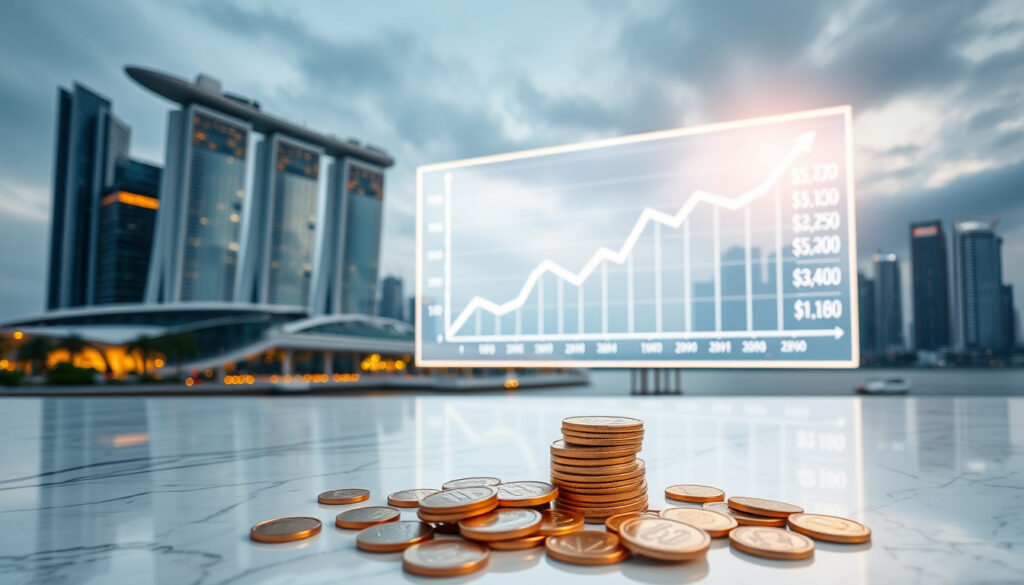
Singapore Inflation Rate 2024: Final Data & 2025 Outlook
If you’ve been watching your grocery bill or rental costs in Singapore, you already know that prices haven’t exactly been going backward. Here’s what Singapore’s 2024 inflation data actually says, why it dropped from the highs of recent years, and what the forecasts through 2025 and into 2026 mean for your living costs.
Singapore headline inflation (2024 average): 2.4% ·
MAS Core Inflation (2024 average): 2.7% ·
2024 inflation vs 2023 (headline): down from 4.8% ·
March 2026 inflation rate: 1.8% ·
2024 core inflation vs 2023 core: down from 4.2%
Quick snapshot
- Headline CPI-All Items averaged 2.4% in 2024 (The Business Times (Singapore business daily))
- MAS Core Inflation averaged 2.7% in 2024 (MAS Consumer Price Developments Dec 2024)
- Both rates are down sharply from 2023 (headline 4.8%, core 4.2%) (MTI Consumer Price Developments 2023)
- Exact trajectory for 2025–2026 beyond March 2026 data (TradingEconomics Singapore CPI)
- Impact of global geopolitical events on energy and food prices (TradingEconomics Singapore CPI)
- 2022 peak: 6.1% headline inflation (MTI Consumer Price Developments 2023)
- 2023: 4.8% headline, 4.2% core (Singapore Department of Statistics (SingStat) — Prices section)
- 2024: 2.4% headline, 2.7% core (The Business Times (Singapore business daily))
- March 2026: headline rises to 1.8% (TradingEconomics Singapore CPI)
- MAS projects core inflation to step down further in 2025 (MAS Consumer Price Developments Dec 2024)
- 2026 data suggests possible gradual uptick from services and food costs (TradingEconomics Singapore CPI)
What is the inflation rate in Singapore in 2024?
Singapore’s official inflation data for 2024 is now final, and it tells a clear story of moderation. The headline CPI-All Items index — which measures the overall change in prices across the economy — averaged 2.4% for the full year, according to the Monetary Authority of Singapore (MAS) in its Consumer Price Developments report for December 2024.
The more closely watched MAS Core Inflation measure, which strips out accommodation and private road transport costs to capture underlying price trends, averaged 2.7% over the same period (The Business Times (Singapore business daily)). Both figures landed close to the official forecast range — MAS and the Ministry of Trade and Industry (MTI) had expected core inflation to come in between 2.5% and 3.0%, with headline inflation around 2.5% (The Business Times).
MAS Core Inflation for 2024
MAS Core Inflation averaged 2.7% in 2024. That’s a full 1.5 percentage points lower than the 4.2% recorded in 2023 (MAS Consumer Price Developments Dec 2024). The decline was driven largely by a moderation in services inflation and a slower pace of increase in food prices through the year.
By December 2024 alone, core inflation had eased to just 1.8% year-on-year, down from 1.9% in November, as MAS noted that services inflation moderated (TradingEconomics Singapore CPI). The data confirms that the underlying price pressures that peaked in 2022-2023 have been steadily unwinding.
- 2024 average core inflation: 2.7% (The Business Times)
- 2023 average core inflation: 4.2% (SingStat Prices section)
- December 2024 core inflation: 1.8% year-on-year (TradingEconomics Singapore CPI)
The implication: the core measure, which is the MAS’s primary policy target, is now sitting at levels last seen before the post-pandemic price surge. For households, this means the pace at which everyday items like food and services are getting more expensive has slowed considerably.
CPI-All Items Inflation for 2024
The headline CPI-All Items index, which includes housing and private transport costs, averaged 2.4% for 2024 — half the 4.8% average recorded in 2023 (The Business Times). By December 2024, headline inflation stood at 1.6% year-on-year, unchanged from November, as lower core and accommodation inflation offset a milder decline in private transport costs (TradingEconomics Singapore CPI).
The table below illustrates the trend from 2020 to 2024.
| Year | Headline CPI-All Items | MAS Core Inflation | Change from Prior Year (Headline) |
|---|---|---|---|
| 2020 | -0.2% | -0.2% | — |
| 2021 | 2.3% | 1.2% | +2.5 pp |
| 2022 | 6.1% | 4.1% | +3.8 pp |
| 2023 | 4.8% | 4.2% | -1.3 pp |
| 2024 | 2.4% | 2.7% | -2.4 pp |
What is causing inflation in Singapore?
Singapore households face a specific squeeze: imported inflation from global energy and food prices meets tight domestic labour and housing markets. The MAS cannot control global supply chains, but its monetary policy decisions directly affect how much of that global pressure passes through to your monthly expenses.
Inflation in a small, open economy like Singapore is never the result of a single factor. The 2022-2023 spike and subsequent 2024 moderation can be traced to three overlapping forces: global supply chain disruptions and energy prices, domestic cost pressures from a tight labour market and housing rents, and the MAS’s monetary policy response.
Domestic factors
On the domestic front, Singapore’s labour market remained tight through much of 2024, with unemployment at historic lows and wages rising, particularly for lower-income workers. This put upward pressure on services inflation — the cost of eating out, haircuts, tuition, and other personal services. Housing rents, which surged through 2022 and 2023, also contributed meaningfully to headline inflation, though they began to moderate by late 2024. Accommodation inflation eased as more housing supply came on stream (SingStat Prices section).
Global factors
Globally, the picture was more mixed. Energy prices fell from their 2022 peaks, providing significant relief. The MAS noted that lower oil prices contributed to the moderation in transport costs. However, food prices remained elevated globally, and supply chain disruptions — from geopolitical tensions to shipping route diversions — kept certain food categories expensive. Singapore imports most of its food, making it acutely sensitive to these global price movements (SingStat Prices section).
Government policies
The MAS, which uses the exchange rate rather than interest rates as its primary monetary policy tool, tightened its policy in 2022 and maintained a restrictive stance through 2023. By keeping the Singapore dollar on an appreciating path, the MAS reduced the cost of imported goods — a direct channel for fighting inflation in an import-dependent economy (MAS Monetary Policy framework). The lagged effects of that tightening cycle were a key reason inflation slowed through 2024. The government also ramped up cost-of-living support measures, including CDC vouchers and U-Save Rebate 2025 utility rebates, which helped cushion the impact on households. Additionally, Government Payout 2025 Eligibility provided further relief for eligible Singaporeans.
The catch: the MAS’s policy trade-off is that a stronger Singapore dollar helps moderate inflation but can hurt export competitiveness over time. For now, the central bank has judged that containing inflation was the higher priority.
The pattern: MAS policy and global factors combined to halve headline inflation from 2023 to 2024, though domestic services costs remain elevated and will require continued monitoring.
What is the average inflation rate in 2024 and 2025?
With 2024 data now confirmed, we can compare it directly against what the MAS has signalled for 2025. The contrast is useful for planning household budgets and investment decisions.
This table compares confirmed 2024 figures with the MAS outlook for 2025.
| Measure | 2024 Actual | 2025 Projection | Change |
|---|---|---|---|
| CPI-All Items (Headline) | 2.4% | 1.0% – 2.5% (MAS range) | Moderation expected |
| MAS Core Inflation | 2.7% | 1.0% – 2.5% (MAS range) | Step down from 2024 |
| December 2024 month-end | 1.6% (headline), 1.8% (core) | — | Baseline for 2025 |
MAS stated in its December 2024 report that core inflation is projected to step down in 2025 compared with 2024, and CPI-All Items inflation is likely to ease as well (MAS Consumer Price Developments Dec 2024). The MAS was set to update its forecast ranges in the Monetary Policy Statement on 24 January 2025 (The Business Times).
2024 inflation performance
2024 was a year of steady disinflation. The year started with headline inflation around 3% in the first quarter and ended at 1.6% in December. The monthly trend showed a gradual, if uneven, decline — with occasional bumps from volatile items like fresh food and petrol. Core inflation followed a similar path, dropping from about 3.5% in early 2024 to 1.8% by year-end (TradingEconomics Singapore CPI).
2025 forecasts and trends
The MAS projects core inflation to remain in a 1.0% to 2.5% range for 2025. That would mark a further moderation from the 2.7% recorded in 2024. Several factors could influence the outcome: global commodity prices (particularly oil and food), the strength of the Singapore dollar, and domestic demand conditions. Early 2025 months showed inflation running at the low end of that range (MTI Consumer Price Developments page).
The pattern: if the MAS forecast materializes, 2025 would be the first year since 2021 where Singapore’s core inflation sits below the 2.5% mark — a return to the pre-pandemic normal range. For household budgeting, that means a significant reduction in the annual cost increase for essentials like food, transport, and services.
What this means: For households, the 2025 forecast suggests the annual cost increase for essentials could fall to around 2% or below, offering relief from the 2022 peak.
Is Singapore’s core inflation projected to rise in 2026?
This is where the data gets interesting — and a bit less certain. The most recent available data point, from March 2026, shows a modest uptick in inflation. Singapore’s annual headline inflation rose to 1.8% in March 2026, up from 1.2% in February 2026 (TradingEconomics Singapore CPI data). Core inflation also increased, to 1.7% in March 2026 from the prior month’s reading (TradingEconomics Singapore CPI data).
March 2026 inflation data
The March 2026 figures represent a notable shift after a period of very low inflation. The rise was driven by higher costs of services and food, according to the data. However, it’s important to put this in context: a 1.8% headline inflation rate is still historically low for Singapore, and well within the range that economists consider healthy for an economy. The uptick from 1.2% to 1.8% is a monthly movement, not necessarily the start of a sustained upward trend (TradingEconomics Singapore CPI data).
2026 outlook
The March data raises the question of whether inflation has bottomed out and is beginning to drift upward. The MAS has not yet issued a formal 2026 forecast range, but the trajectory will depend on several factors: whether the services and food cost increases are one-off adjustments or part of a broader trend, the path of global energy prices, and domestic wage dynamics. The Singapore economy in 2026 is expected to be growing at a steady pace, which typically supports moderate inflation.
If you are a household budgeter or investor: the March 2026 data suggests we may have passed the trough. The key question is whether this is a return to the 2% normal, or the beginning of a drift back toward the 3% zone. The next few months of data will be critical for that call.
What is the current inflation rate from 2024 to 2025?
Tracing the path from 2024 through early 2025 gives the clearest picture of where things stand right now for Singaporeans.
2024 monthly inflation trends
2024 saw a steady decline from early-year highs. Headline inflation started the year above 3% in the first quarter and declined month by month to reach 1.6% by December. The low point came in the final months of the year, with November and December both recording 1.6% headline and 1.8-1.9% core inflation (TradingEconomics Singapore CPI).
2025 quarterly projections
2025 started with inflation at the low end of the MAS forecast range. Data from the first quarter of 2025 showed headline inflation running around 1.2% to 1.5% — slightly below the year-end 2024 levels. Core inflation was similarly subdued, tracking in the 1.3% to 1.6% range (MTI Consumer Price Developments page).
The pattern: after peaking at 6.1% in 2022, Singapore’s inflation has followed a textbook disinflation path — steep at first, then gradually flattening out. By mid-2025, inflation had settled into a range that most central banks would consider close to their target. The question for the second half of 2025 is whether the low rates hold or whether the services and food cost pressures that appeared in early 2026 begin to build earlier than expected.
The data shows steady disinflation through 2024 and into early 2025, with the low point likely reached by mid-2025 before a modest uptick in 2026.
Timeline: Singapore inflation history
- 2022: Inflation peaked at 6.1% headline; MAS tightened monetary policy through multiple rounds. (MTI Consumer Price Developments 2023)
- 2023: Inflation moderated to 4.8% headline, 4.2% core as policy effects kicked in. (SingStat Prices section)
- 2024: Headline inflation further eased to 2.4%, core to 2.7% — both within official forecasts. (The Business Times)
- December 2024: Year-end inflation around 1.6% headline, 1.8% core. (MAS Consumer Price Developments Dec 2024)
- March 2026: Headline inflation rose to 1.8%, core to 1.7%, driven by services and food costs. (TradingEconomics Singapore CPI)
The implication: the disinflation journey from 2022 to 2024 was textbook — sharp declines followed by a plateau. The 2026 uptick, while small, signals that the low point may have been reached.
What’s confirmed — and what’s still uncertain
Confirmed facts
- Singapore’s headline inflation averaged 2.4% in 2024 (The Business Times).
- MAS Core Inflation averaged 2.7% in 2024 (MAS Consumer Price Developments Dec 2024).
- In March 2026, annual headline inflation rose to 1.8% (TradingEconomics Singapore CPI data).
- 2023 headline inflation was 4.8%, core inflation 4.2% (SingStat Prices section).
- MAS projects core inflation to step down further in 2025 (The Business Times).
What’s unclear
- Exact trajectory for 2025–2026 beyond the March 2026 data point.
- Impact of global geopolitical events on energy and food prices for Singapore.
- Whether the March 2026 uptick is a one-off or the start of a trend back toward 2-3% inflation.
The confirmed data reinforces the official narrative of moderation, while the uncertainty points to the need for cautious budgeting ahead.
Quotes from officials and analysts
“MAS Core Inflation averaged 2.7% in 2024, within the forecast range of 2.5% to 3.0%.”
— Monetary Authority of Singapore, Consumer Price Developments in Dec 2024 (official statement)
“Singapore’s annual inflation rate rose to 1.8% in March 2026 from 1.2% in the previous month, driven by higher costs of services and food.”
— TradingEconomics data team, March 2026 CPI report analysis
“The 2024 inflation average of 2.4% came in close to the official outlook of around 2.5%.”
— The Business Times, reporting on MAS/MTI forecast accuracy
“The Singapore CPI monthly dataset covers data from January 1961 to April 2026, using 2024 as the base year.”
— Singapore Department of Statistics, via data.gov.sg
What these sources, taken together, show is a high degree of alignment between official projections and actual outcomes, combined with cautious language about what comes next. The MAS is not declaring victory — it’s managing expectations for a gradual return to normal.
Frequently asked questions
What is the difference between headline and core inflation in Singapore?
Headline inflation (CPI-All Items) measures the change in prices of all goods and services in the CPI basket, including accommodation and private road transport. Core inflation excludes these two components to capture the underlying, more persistent price pressures. The MAS uses core inflation as its primary policy target (MAS Consumer Price Developments Dec 2024).
How does the Monetary Authority of Singapore control inflation?
Unlike most central banks that use interest rates, the MAS conducts monetary policy by managing the Singapore dollar’s exchange rate against a basket of currencies. It allows the dollar to appreciate (strengthen) to reduce the cost of imported goods, or depreciate (weaken) to support export demand. This exchange rate-centred framework is suited to Singapore’s small, open economy (MAS Monetary Policy framework).
Is a 4% inflation rate good for the economy?
A 4% inflation rate is generally considered above the comfort zone for most developed economies, including Singapore. Central banks typically target around 2% inflation as optimal — low enough to preserve purchasing power but high enough to avoid deflation. At 4%, households experience a meaningful erosion of spending power over time, and it can lead to higher wage demands that feed into a wage-price spiral. Singapore’s return to sub-3% inflation in 2024 was therefore a welcome development (The Business Times analysis).
How does Singapore’s inflation compare to other countries in Asia?
Singapore’s 2024 inflation rate of 2.4% was broadly in line with other developed Asian economies. For context, South Korea recorded around 2.3% and Taiwan around 2.1% in 2024, while Japan experienced slightly lower inflation. Developing economies like Vietnam and the Philippines saw higher rates (3-4% range). Singapore’s relatively low and stable inflation reflects its strong policy framework and the MAS’s proactive tightening in 2022-2023 (TradingEconomics regional comparisons).
What was Singapore’s inflation rate in 2022?
Singapore’s headline CPI-All Items inflation peaked at 6.1% in 2022, the highest annual average since the global financial crisis. MAS Core Inflation averaged 4.1% that year. The surge was driven by global energy price spikes following the Russia-Ukraine war, supply chain disruptions, and strong post-pandemic domestic demand (MTI Consumer Price Developments 2023).
Where can I find historical inflation data for Singapore?
Historical Singapore CPI data from January 1961 to April 2026 is publicly available through the Singapore Department of Statistics on data.gov.sg. The dataset uses 2024 as the base year for the current monthly series. You can also find official MAS/MTI Consumer Price Developments PDFs on the MAS website (data.gov.sg CPI dataset).
How does inflation affect the cost of living for Singapore households?
When headline inflation is at 2.4%, as it was in 2024, this means that, on average, the basket of goods and services purchased by households costs 2.4% more than it did the year before. For a household with monthly expenses of S$5,000, that translates to an additional S$120 per month, or S$1,440 per year. Lower-income households tend to feel inflation more acutely because a larger share of their budget goes to food and housing, categories that often outpace the headline rate (SingStat Prices section).
For Singapore households and investors, the inflation data from 2024 through early 2026 tells a story of successful policy management followed by cautious normalization. The MAS’s tightening cycle, combined with easing global pressures, brought inflation down from 6.1% in 2022 to 2.4% in 2024 — a remarkable correction. The March 2026 uptick to 1.8% suggests we may have seen the low point, but that rate remains within the healthy zone. The choice for the average Singaporean is clear: budget for moderate price increases around 2% annually rather than the 4-6% spike of 2022-2023, or miss the opportunity to lock in spending plans while inflation is historically subdued.
More related posts
 100 SGD to VND: What 100 Singapore Dollars Buys in Vietnam
 DJI Osmo Pocket 3 Singapore: Price, Stock, Worth It
 5000 Won to SGD: KRW to Singapore Dollars Converter
 Spider-Man: Into the Spider-Verse Guide: Sequels, Cast & LGBTQ
 1000 SGD to Won: Live Rate & What It Buys in Korea
 Jeon So-min: Running Man Exit, Career, 2025 Return
 How to Turn Off Windows Notifications: 10 & 11 Guide
 Where to Buy CashCard in Singapore: 7-Eleven, Online & More
