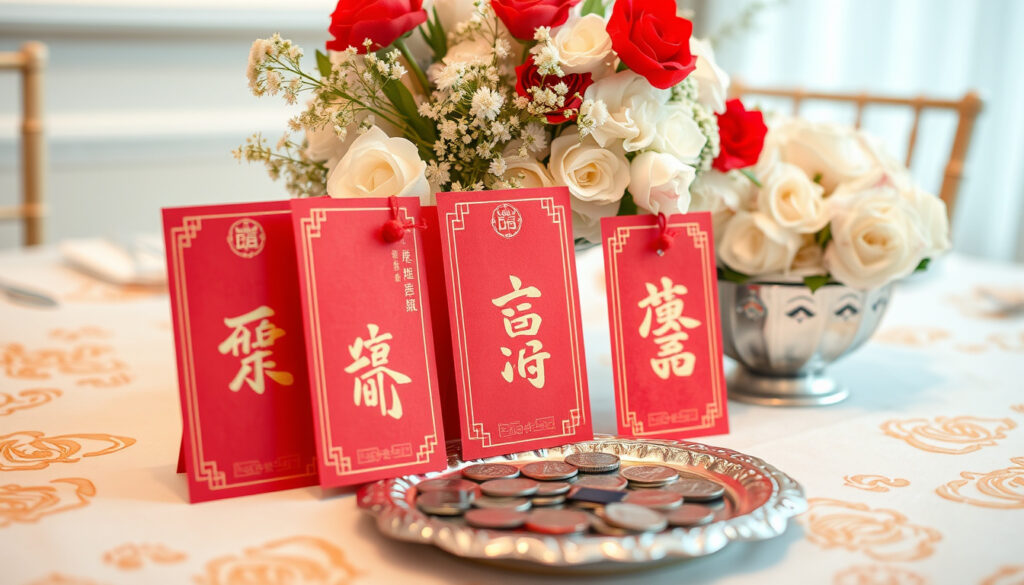
Wedding Ang Bao Rates 2025: How Much to Give in Singapore
Anyone who’s RSVP’d to a wedding in Singapore this year has likely asked the same quiet question: how much should I actually put in the ang bao? With 2025 venue prices climbing and inflation pressing on budgets, the old rule of thumb no longer fits every table — this guide breaks down per-person rates by venue tier, lowest acceptable amounts, and lucky number etiquette.
Typical range per guest (Singapore hotels): S$120 to S$200 ·
Lowest acceptable amount (casual setting): S$80 ·
Average increase vs 2024: 5-10% ·
Venues updating rates quarterly: Many high-end hotels
Quick snapshot
- S$80 is the floor for formal wedding dinners in 2025 (Blissful Brides)
- Even numbers are lucky; amounts with ‘4’ are avoided (AsiaOne)
- Exact 2026 rates are speculative until venues publish
- Helper amounts vary widely without a single standard
- 2023 average: S$100-S$160 (Blissful Brides, AsiaOne)
- 2025 average: S$120-S$200 (Blissful Brides, AsiaOne)
- Venues updating pricing quarterly; e-ang bao adoption rising (Blissful Brides)
- Inflation impact on 2025 budgets not fully quantified (Blissful Brides)
The key figures for 2025 ang bao giving at a glance:
| Metric | Value |
|---|---|
| 2025 average hotel ang bao range | S$120-S$200 per pax |
| Lowest acceptable for formal dinner | S$80 per pax |
| Most common lucky amount | S$88 |
| Helper ang bao typical range | S$28-S$88 |
| Update frequency of rates | Quarterly (some monthly) |
What is the market rate for wedding ang bao?
2025 averages by venue tier
A guest at a 2025 hotel wedding in Singapore is now covering S$120 to S$200 per person — a 5-10% jump from 2024 that outpaces typical salary increments for many working professionals.
Singapore wedding ang bao guides in 2025 commonly estimate the gift amount by taking venue wedding package pricing and dividing by ten seats per table, then rounding up to the nearest S$10, according to Blissful Brides (Singapore wedding planning platform). The method gives a per-person target that covers the couple’s cost while adding a token of goodwill.
Recommendations vary by venue type, day of week, and timing, with weekday luncheons typically costing the least. At the top end, AsiaOne’s (Singapore news and lifestyle publication) 2025 guide lists The Barracks Hotel Sentosa as the most expensive venue in its ranking, with rates up to S$780 per pax, and Capella Singapore at up to S$450 per pax. For those aiming to match the venue’s cost, here are per-person rates at major Singapore venues in 2025:
| Venue | Weekday range (per pax) | Weekend range (per pax) |
|---|---|---|
| Marina Bay Sands | S$290 | S$350 |
| JW Marriott Hotel Singapore South Beach | S$290 | S$340 |
| Mandarin Oriental Singapore | S$240 | S$300 |
| Jewel Changi Airport | S$270 | S$300 |
| Mandai Wildlife Reserve | S$250 | S$390 |
| Mercure Singapore Bugis | S$140 | S$230 |
| Holiday Inn Express & Suites Singapore Novena | S$120 | S$160 |
| Ah Yat Seafood Restaurant | S$100 | S$160 |
Blissful Brides notes that rates are updated quarterly, with some premium venues adjusting monthly based on catering cost fluctuations. The gap between weekday and weekend pricing can be as wide as S$140 at Mercure Bugis — a meaningful difference for guests on a budget.
The implication: choosing a weekday banquet or a lunch reception can lower the recommended ang bao by S$40 to S$100 per person, giving guests more flexibility without under-gifting.
How to calculate per pax cost
The standard formula is straightforward: take the venue’s wedding package price per table, divide by ten seats, and round up to the nearest S$10. For example, a S$1,200 table works out to S$120 per person — so S$120 becomes the minimum recommended ang bao for that wedding.
Most guides from Blissful Brides and AsiaOne now include inflation-adjusted figures that factor in 2025 catering and labour cost increases. The recommended amount should cover the couple’s cost per head plus a small token — typically an extra S$10 to S$20 on top of the per-pax venue price.
The trade-off: applying this formula to a S$3,900 table at The Barracks Hotel Sentosa yields a suggested ang bao of S$390 per person, but many guests attending high-end weddings give less than the full per-pax cost and rely on the couple’s understanding that the gift is symbolic, not a full reimbursement.
What is the lowest acceptable Angbao amount?
Minimum for casual settings vs formal banquets
Giving below S$80 at a hotel banquet in 2025 means the couple likely loses money on your seat — and in Singapore’s gifting culture, that can leave a lasting impression.
S$80 is widely cited as the minimum for a basic wedding meal in 2025, according to Blissful Brides. For a casual restaurant wedding or a lunch reception at a mid-tier venue like Ah Yat Seafood Restaurant, where per-pax cost ranges from S$100 to S$160, S$80 may still be considered low but is generally acceptable if the guest has a close relationship with the couple.
For formal hotel banquets, the floor rises. Even at the more affordable Holiday Inn Express & Suites Singapore Novena, where rates start from S$120 per pax, giving S$80 would leave the couple covering the difference. The lowest acceptable amount varies by venue cost per pax, and most etiquette guides recommend matching or exceeding the venue’s per-person cost.
What this means: if you’re attending a 2025 wedding at a venue you haven’t checked, the safe minimum is S$80 for casual settings and S$120 for hotel banquets — anything below risks being noticed.
Is $5 ok for ang bao?
$5 is not acceptable for wedding dinners but may be symbolic for helpers or as a token for tea ceremony attendants, according to AsiaOne. The denomination is odd (an odd number in Chinese tradition is associated with funeral rites) and it falls far short of covering any meal cost in 2025 Singapore.
For weddings, the smallest practical ang bao for a guest is S$10, and even that is only appropriate for very casual, no-meal events like a simple register-office ceremony. For any sit-down meal, the minimum starts at S$80.
The catch: some younger couples now accept smaller amounts from student guests or friends who are clearly struggling, but the standard advice remains — if you can’t afford the venue’s per-pax cost, consider giving a smaller amount and explaining your situation, or decline the invitation.
How much ang pow to give for wedding helpers?
Guidelines for helpers in Singapore
Helpers typically receive S$28 to S$88 based on role and closeness to the couple, according to Blissful Brides. The range is deliberately wide because the role of a “helper” spans everything from a sibling managing the guestbook to a close friend coordinating the bridal party.
- Xiongdi (brothers) / Jiemei (sisters): S$28 to S$68 per person — covers their effort and transport costs.
- Emcee or photographer friend: S$68 to S$88 — acknowledges their professional-level contribution.
- Tea ceremony attendants: S$18 to S$38 — symbolic, since the role is part of the ceremony.
Etiquette suggests giving a lucky even number (no $5). Couples may give helpers a smaller ang bao plus a meal, which is considered appropriate since helpers are already eating at the wedding.
The pattern: helper amounts are less about covering costs and more about expressing gratitude — the couple is not reimbursing a meal but thanking someone for their time and effort on the day.
Red packet etiquette for supporting roles
Helpers should receive their ang bao privately, not at the reception table. The couple typically prepares red packets in advance and hands them out during the pre-wedding preparations or after the ceremony.
Unmarried helpers are often given a slightly higher amount as a goodwill gesture, while married helpers may receive a standard rate. The key rule across all roles: the amount should be an even number, and amounts containing the digit ‘4’ should be avoided because it sounds like the word for “death” in Chinese.
Why this matters: getting the helper ang bao wrong can create awkwardness in close relationships — a too-low amount feels dismissive, while an overly high one can embarrass the recipient.
What is the lucky amount to give at a Chinese wedding?
Even numbers and digit symbolism
Choosing S$88 instead of S$80 may seem like a small difference, but in Chinese wedding tradition, that extra S$8 signals good fortune — and the couple will notice the intention behind the number.
Even numbers are preferred; odd numbers are associated with funerals, according to AsiaOne (Singapore money and lifestyle publication). S$88, S$108, and S$188 are commonly chosen for auspiciousness because the digit ‘8’ sounds like “prosper” in Chinese. Other popular amounts include S$68 (sounds like “smooth” or “luck”), S$128 (a doubling of the lucky 28), and S$288 (double prosperity).
The most common lucky amount across all 2025 guides is S$88, which balances auspiciousness with affordability for most guests.
Avoiding unlucky amounts
Amounts containing ‘4’ are avoided because the digit sounds like the word for “death” in Mandarin, Cantonese, and other Chinese dialects. This means S$40, S$44, S$84, and S$140 are all considered inauspicious for wedding ang bao.
Single dollar amounts (S$1, S$5, S$7) are also avoided because odd numbers are associated with funeral rites. The safest approach is to give an even-numbered amount that ends in a lucky digit — S$88, S$108, S$168, or S$288 being the most common choices.
The pattern: the perceived value of the ang bao in Chinese wedding culture is a combination of the monetary amount and the numerological meaning — a S$88 ang bao is considered more thoughtful than a S$100 one because of the intentional auspiciousness.
How much to give ang bao if not attending?
Etiquette for declining a wedding invitation
If not attending, ang bao is usually S$50 to S$80 to cover a portion of the couple’s cost, according to Blissful Brides. The amount is lower than an attending guest’s because the couple is not paying for your meal, but it still acknowledges the relationship and the couple’s expenses. Closer relationships may warrant a higher amount even without attendance. For a sibling or close cousin, S$100 to S$200 is still appropriate even if you can’t attend, because the relationship matters more than the meal cost.
Sending money digitally or via e-ang bao is now common, with platforms like PayNow and DBS PayLah! offering e-ang bao features that let you send a digital red packet with a personalised message.
Suggested amount range
- Colleague or acquaintance: S$30 to S$50 — a token of goodwill.
- Friend or distant relative: S$50 to S$80 — covers a portion of the couple’s per-person cost.
- Close friend or cousin: S$80 to S$120 — closer to the attending rate.
- Immediate family sibling: S$120 to S$200 — reflects the close bond.
The trade-off: giving too little for a non-attendance can signal disinterest, while giving too much may create awkwardness if the couple feels obligated to reciprocate. The standard advice is to match what you would have spent on a gift or transport had you attended.
Timeline: How ang bao rates have changed
- 2023: Average ang bao rate S$100-S$160 per pax, with most venues at the lower end of the range. (Blissful Brides, AsiaOne)
- 2024: Rates increased 3-5% due to inflation in catering and labour costs, moving the average to S$110-S$180. (Blissful Brides)
- 2025: Rates average S$120-S$200, with premium venues like The Barracks Hotel Sentosa and Capella Singapore pushing above S$400. (AsiaOne)
- Ongoing: Venues update pricing quarterly; e-ang bao adoption rises as younger couples prefer digital gifting.
The pattern: the 2025 increase is the steepest in three years, driven by a combination of post-pandemic demand recovery, higher ingredient costs, and increased venue rental fees. Guests who gave S$100 in 2023 now need S$120 to S$150 for the same venue tier.
What we know and what remains unclear
Confirmed facts
- S$80 is the floor for formal wedding dinners in 2025. (Blissful Brides)
- $5 is not acceptable for wedding meals. (AsiaOne)
- Even numbers are lucky; amounts with ‘4’ are avoided. (AsiaOne)
What’s unclear
- Exact 2026 rates are speculative until venues publish.
- Helper amounts vary widely without a single standard.
- Impact of inflation on 2025 wedding budgets is not fully quantified.
Expert perspectives
“The 2025 rates reflect the reality that wedding venues are adjusting pricing quarterly, not annually. Guests who rely on last year’s numbers risk under-gifting by S$20 to S$30 per person.”
— SingaporeBrides editorial team, 2025 wedding cost analysis
“When you look at the per-pax formula, the recommended ang bao has risen about 8% year-on-year since 2023. That’s faster than the average salary increment in Singapore, which means guests are feeling the pinch.”
— MoneySmart financial writer, 2025 inflation impact report
“The shift to e-ang bao is changing the game — younger guests are more comfortable sending S$88 via PayNow than fumbling with cash in a red packet. But the etiquette around the amount hasn’t changed.”
— You.co blog, Singapore gifting trends 2025
Making your decision
For the Singapore wedding guest in 2025, the choice is clear: check the venue’s per-pax cost before you give, round up to the nearest S$10, and choose a lucky even number. Give below S$80 at a hotel banquet and you risk the couple remembering your table cost more than your presence. The safe range is S$120 to S$200 for most hotel weddings, S$80 to S$100 for casual venues, and S$28 to S$88 for helpers. With venues updating rates quarterly and inflation still pressing, the old rule of “S$100 for a hotel wedding” no longer holds — and the couple will thank you for doing the math.
singsaver.com.sg, moneykinetics.sg, aluxe.com, cnbc.com, you.co
Frequently asked questions
What is the average wedding ang bao amount in 2025?
The average is S$120 to S$200 per person for hotel weddings, S$80 to S$100 for casual restaurant venues, and S$80 to S$120 for church or temple weddings. The most common single amount given is S$88.
How much should I give for a wedding lunch ang bao?
Wedding lunches typically cost 10-20% less than dinners, so the recommended ang bao is S$100 to S$160 for hotel lunches and S$80 to S$120 for restaurant lunches. Weekday lunches are the most affordable option for guests.
What is the difference between ang bao and ang pow?
There is no difference — “ang bao” (Mandarin) and “ang pow” (Hokkien) both refer to the red packet containing money given as a wedding gift. “Ang pow” is more commonly used in Singaporean colloquial speech, while “ang bao” is the standard Mandarin term.
Should I give ang bao if I attend a wedding alone?
Yes, and the amount should still cover one person’s meal cost. Even if you attend solo, the couple has paid for your seat. The recommended amount is the same as for any individual guest — S$120 to S$200 for hotel weddings.
Do I need to give ang bao for a second wedding?
Etiquette is less strict for second weddings. A smaller amount of S$80 to S$120 is generally acceptable, and some guests choose to give a gift instead of cash. The same even-number and lucky-digit rules apply.
What if I cannot afford the recommended ang bao amount?
Give what you can afford — S$80 is the absolute minimum for a formal dinner. If you are a student or have financial constraints, most couples understand. It is better to give a smaller amount with a sincere note than to skip the wedding entirely.
Is it okay to give ang bao via PayNow or QR code?
Yes, e-ang bao via PayNow, DBS PayLah!, or GrabPay is now widely accepted and even preferred by younger couples. The etiquette around the amount remains the same as for cash ang bao. Just send a message with the transfer so the couple knows who it’s from.
What is the etiquette for opening ang baos?
Ang baos are traditionally opened in private after the wedding. In modern Singapore practice, some couples open them at the end of the night to thank guests, but most wait until after the honeymoon. Never open an ang bao in front of the giver.
More related posts
 How to Cure Mouth Ulcers Fast Naturally
 E2i Job Fair 2025 – Complete Toronto Guide for Newcomers
 What to Eat at VivoCity: Food Guide, Budget Eats & Halal Options
 Windows 11 Home vs Pro: Key Differences and Which to Choose
 Huawei Pura X Singapore: Price, Specs & Legality
 Al-Nassr vs Kawasaki – 2-3 Semi-Final Upset
 Bedok Mall Food Directory: Restaurants, Eats & Guide
 Happy Teachers Day Card: Best Messages, Quotes & Design Ideas
