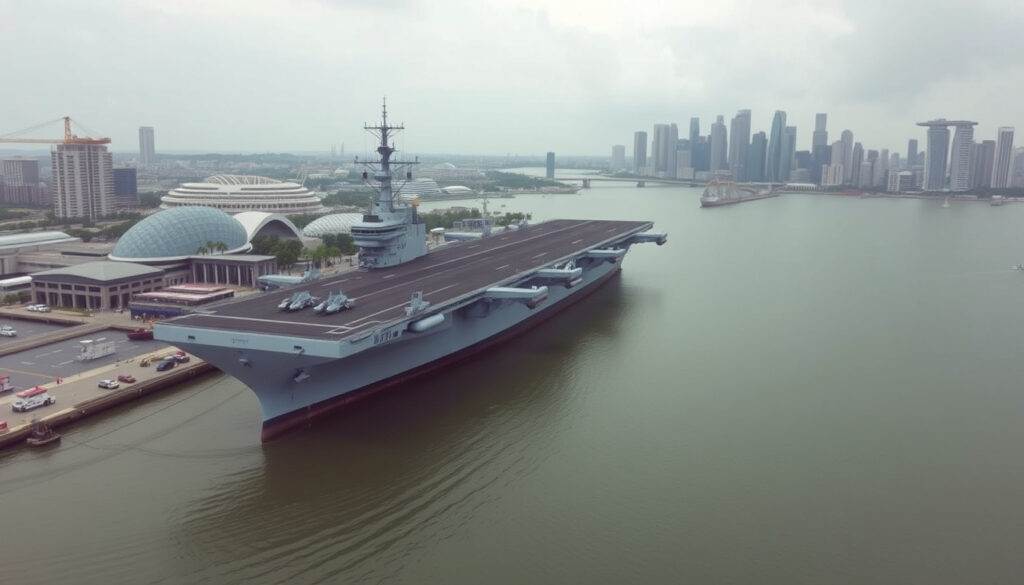
HMS Prince of Wales in Singapore: 2025 Visit Details & Facts
When a 65,000-tonne aircraft carrier glides into Marina Bay, even Singaporeans used to world-class naval visits tend to stop and look. HMS Prince of Wales, the Royal Navy’s fleet flagship, docked in Singapore on 24 June 2025 as the centrepiece of the UK’s Carrier Strike Group 25 deployment — an eight-month mission that signals Britain’s post-Brexit re-engagement with the Indo-Pacific.
Length: 284 meters (932 feet) ·
Displacement: 65,000 tonnes ·
Crew capacity: Up to 1,600 (including air group) ·
Aircraft capacity: Up to 36 F-35B Lightning II jets ·
Homeport: HMNB Portsmouth, UK ·
Current deployment: Indo-Pacific, docked in Singapore (June 2025)
Quick snapshot
- HMS Prince of Wales docked in Singapore on 24 June 2025 (Forces News (UK defence outlet))
- Ship is berthed at Changi Naval Base during its second 2025 port call (The Maritime Executive (shipping industry journal))
- UK has no permanent military base in Singapore since withdrawal in 1971 (Forces News (UK defence outlet))
- Singapore ordered 12 F-35B Lightning II jets in 2023 (Forces News (UK defence outlet))
- Exact departure date from Singapore (not publicly confirmed)
- Number of F-35B jets on board HMS Prince of Wales during this visit
- The carrier arrived in Singapore on 24 June 2025 (Forces News (UK defence outlet))
- Deployment runs April–December 2025 (Operation Highmast) (Forces News (UK defence outlet))
- Carrier joined Bersama Lima exercise after leaving Singapore (The Maritime Executive (shipping industry journal))
- Carrier expected to participate in further Indo-Pacific exercises
- First F-35 deliveries to Singapore expected in 2026
- Deployment due to conclude December 2025; sailors home for Christmas
Six key facts sum up the current deployment of HMS Prince of Wales and what it signals about the UK’s strategic posture:
| Attribute | Value |
|---|---|
| Ship name | HMS Prince of Wales (R09) |
| Class | Queen Elizabeth-class aircraft carrier |
| Commissioned | 2019 |
| Current location | Marina Bay Cruise Centre, Singapore |
| Arrival date | 24 June 2025 |
| Flag | Royal Navy, United Kingdom |
Singapore’s role as a port call — rather than a base — allows the UK to project naval power in Southeast Asia without the political and financial burden of a permanent garrison. For a city-state that prides itself on neutrality, hosting the Royal Navy’s flagship is a calculated statement of defence partnership.
How long will the HMS Prince of Wales be in Singapore?
HMS Prince of Wales arrived in Singapore on 24 June 2025 after transiting the South China Sea as part of Operation Highmast, a UK-led deployment that began when the Carrier Strike Group sailed from Portsmouth in April 2025. The Maritime Executive reported that the carrier was scheduled to remain in port until 25 September 2025, after which it departed to take part in the Five Power Defence Arrangements exercise Bersama Lima — an annual air, land, and maritime exercise focused on defending Malaysia and Singapore.
Current docking schedule at Marina Bay Cruise Centre
- The ship berthed at Changi Naval Base during its second 2025 port call, according to The Maritime Executive
- The first port call in June 2025 saw the carrier docked at Marina Bay Cruise Centre (Forces News)
- Exact departure date from the second visit has not been publicly confirmed
Purpose of the Indo-Pacific deployment
Operation Highmast is an eight-month deployment covering roughly 30,000 to 40,000 nautical miles across the Mediterranean, the Middle East, the Indian Ocean, and the Indo-Pacific, according to Forces News and the Royal Navy’s own video summary. The UK Ministry of Defence described the multinational participation — including ships from Japan, Canada, Australia, and South Korea — as demonstrating “combined strength and readiness,” as reported by Forces News.
Where can I see the HMS Prince of Wales in Singapore?
The aircraft carrier is a spectacular sight, but public access is tightly controlled. Here is exactly where you can see it and what restrictions apply.
Best public viewing points: Marina Bay area and Singapore Cultural Centre rooftop garden
- The ship is docked at Marina Bay Cruise Centre, according to Forces News
- Visible from the Singapore Cultural Centre rooftop garden
- External views are possible from nearby public spaces along the Marina Bay waterfront
Public access and security restrictions
No public boarding is permitted, consistent with standard Royal Navy operational security during foreign port calls. However, the ship’s 284-metre length and towering island structure make it conspicuous from the Marina Bay area and the Singapore Cultural Centre rooftop garden, which offers an elevated view of the berth.
The best photo opportunities come with caveats: security perimeters prevent close approaches, and the ship’s schedule can change without notice. Morning hours typically offer better light and fewer crowds along the waterfront.
How do 5,000 people eat, sleep, and work on an aircraft carrier?
The 5,000 figure often quoted includes the embarked air group; the ship’s company of the Queen Elizabeth-class carrier is approximately 1,600 personnel. Daily life aboard HMS Prince of Wales is a highly choreographed operation.
Daily routines and living quarters on HMS Prince of Wales
- Sleeping quarters are compartmentalized with shared berths
- Crew work is organized in 12-hour shifts during flight operations
- The ship has multiple galleys serving three meals per day
- Watchkeeping, weapons training, damage control, and rapid-response drills are part of daily routine, according to Forces News
Galley operations and meal schedules
The carrier’s galleys operate around the clock, producing thousands of meals daily. Royal Navy catering standards are generally well-regarded, and Singapore port calls give the crew an opportunity to experience local cuisine during shore leave.
Work shifts and aircraft operations
During flight operations, the flight deck becomes one of the most dangerous workplaces in the world. F-35B Lightning II jets operate from the ski-jump ramp, and aircraft movements are coordinated by a team of deck handlers, directors, and engineers working in 12-hour watches.
For Singaporeans seeing the carrier in port, the visible flight deck represents not just military hardware but the daily effort of keeping a city-sized machine running at sea. The ship’s 65,000-tonne displacement and 284-metre length create logistics challenges that mirror small-town management at 20 knots.
Does the UK have a military base in Singapore?
No — and this fact shapes the entire nature of the HMS Prince of Wales visit. Unlike the British withdrawal from east of Suez that ended permanent basing in 1971, the current relationship is built on temporary access and interoperability.
Current UK military presence in Singapore
- UK has no permanent military base in Singapore since withdrawal in 1971
- UK maintains a small defence staff at the British High Commission
- Singapore hosts the UK’s Integrated Global Defence Network hub
Historical context: British military bases before 1971
From 1819 to 1971, British forces maintained a substantial presence in Singapore, including naval docks, airbases, and army garrisons. The 1971 withdrawal under the “East of Suez” policy ended that era. Today’s UK presence is limited to a defence staff at the British High Commission and participation in the Five Power Defence Arrangements — a multilateral pact that also includes Australia, Malaysia, New Zealand, and Singapore.
How many F-35 jets does Singapore have?
Singapore’s F-35 programme is in its early stages, and the city-state does not yet operate the Lightning II in squadron service. Here is the procurement timeline and regional context.
Singapore’s F-35 procurement and delivery timeline
- Singapore ordered 12 F-35B Lightning II jets in 2023
- First deliveries are expected in 2026
- Singapore currently operates F-15SG and F-16C/D fighters
| Airframe | In service | Role |
|---|---|---|
| F-35B Lightning II | Expected 2026 | Short takeoff/vertical landing (STOVL) |
| F-15SG | Current | Air superiority / strike |
| F-16C/D | Current | Multi-role |
Comparison with other regional air forces
By ordering the F-35B — the STOVL variant that can operate from amphibious ships — Singapore signals interest in sea-based aviation, a capability currently unique in Southeast Asia. Regional neighbours Australia and Japan also operate F-35 variants, placing Singapore in a growing network of US-aligned operators.
What is the history of HMS Prince of Wales in Singapore during WW2?
The name HMS Prince of Wales carries heavy historical weight in Singapore. The current aircraft carrier (R09) is the second vessel to bear the name, and its predecessor’s fate remains etched in regional memory.
Sinking of HMS Prince of Wales (1941)
- The WW2 battleship HMS Prince of Wales was sunk on 10 December 1941 off the coast of Malaysia
- Japanese aircraft attacked the battleship and the battlecruiser HMS Repulse
- The sinking killed 327 crew members and was a major blow to Allied naval power in the Pacific
Connection to the fall of Singapore
Just weeks after the sinking, Singapore fell to Japanese forces in February 1942. The loss of the battleship — sent to deter Japanese aggression — became a symbol of the failure of Britain’s defence strategy in Asia. The current HMS Prince of Wales (R09), a Queen Elizabeth-class aircraft carrier commissioned in 2019, is an entirely different vessel, but its deployment to the same waters carries deliberate symbolic resonance.
“The deployment of HMS Prince of Wales to Singapore marks a return to waters where a British flagship was lost 84 years ago — now with a capability that battleship could never have matched.”
Forces News (UK defence outlet)
“The Carrier Strike Group’s presence demonstrates our commitment to the Indo-Pacific and our ability to operate alongside allies and partners in the region.”
UK Ministry of Defence, as quoted by Forces News
The contrast between the two ships is stark: a battleship sunk by air power in 1941 and a carrier designed to project air power in 2025. For Singapore, the HMS Prince of Wales visit is not just a photo opportunity — it is a reminder of how dramatically naval warfare and regional alliances have evolved.
Related reading: East Coast GRC Candidates 2025: Full PAP and WP Lineup · Minister of Transport Singapore: Jeffrey Siow and Leadership
breakingdefense.com, facebook.com, news.usni.org, instagram.com
A detailed account of the carrier’s arrival and docking at Marina Bay can be found in HMS Prince of Wales in Singapore.
Frequently asked questions
Is HMS Prince of Wales the same ship that was sunk in WW2?
No. The current HMS Prince of Wales (R09) is a Queen Elizabeth-class aircraft carrier commissioned in 2019. The WW2 battleship of the same name was sunk on 10 December 1941 off the coast of Malaysia.
Can I tour HMS Prince of Wales in Singapore?
No. Public boarding is not permitted. The ship can be viewed from public spaces along the Marina Bay waterfront and the Singapore Cultural Centre rooftop garden.
What is the UK Carrier Strike Group 25?
CSG25 is the UK-led naval task group deployed under Operation Highmast. It includes the carrier, escort vessels, submarines, and support ships. The deployment runs from April to December 2025, covering approximately 40,000 nautical miles.
How many aircraft can HMS Prince of Wales carry?
The carrier can carry up to 36 F-35B Lightning II jets, along with Merlin helicopters for anti-submarine warfare and airborne early warning.
Why is HMS Prince of Wales in the Indo-Pacific?
The deployment signals the UK’s post-Brexit strategic pivot to the Indo-Pacific. It demonstrates commitment to regional security, strengthens the Five Power Defence Arrangements, and supports the Integrated Global Defence Network.
Does Singapore have F-35 jets yet?
Not yet. Singapore ordered 12 F-35B Lightning II jets in 2023, with first deliveries expected in 2026. Singapore currently operates F-15SG and F-16C/D fighters.
What is the Integrated Global Defence Network?
The Integrated Global Defence Network is a UK initiative to maintain defence partnerships and access arrangements with select countries, including Singapore, without permanent bases. It allows rotational presence, joint training, and logistics support.
The return of HMS Prince of Wales to Singapore waters — 84 years after its battleship namesake was lost — is more than a ceremonial port call. It signals a strategic shift that has tangible consequences: for the UK, a reassertion of global reach; for Singapore, a deepening of defence ties without formal basing; and for the regional balance, a renewed commitment to multilateral exercises like Bersama Lima. For the Royal Navy’s sailors, the Singapore stop offers a rare breather in an eight-month deployment that will eventually bring them home for Christmas. For Singaporeans watching from the Marina Bay shoreline, the carrier on the horizon is a reminder that the geopolitics of the Indo-Pacific are changing — and that their city-state sits at the centre of it.
More related posts
 East Coast GRC Candidates 2025: Full PAP and WP Lineup
 Prince Coffee House 太子咖啡座: Menu, Reviews & 2026 Closing
 Gojek Airport Promo Code 2026: Up to S$6 Off Changi Rides
 Galaxy S25 Live Effect Photo: How to Enable and Use
 Best Free Movie Streaming Sites 2025: Plex, Tubi & More
 Singapore Airlines SG60 Promotion: Discounts, Vouchers & Deals
 APSN Delta Senior School – Guide to Vocational Programmes and Enrolment
 Happy Teachers Day Card: Best Messages, Quotes & Design Ideas
