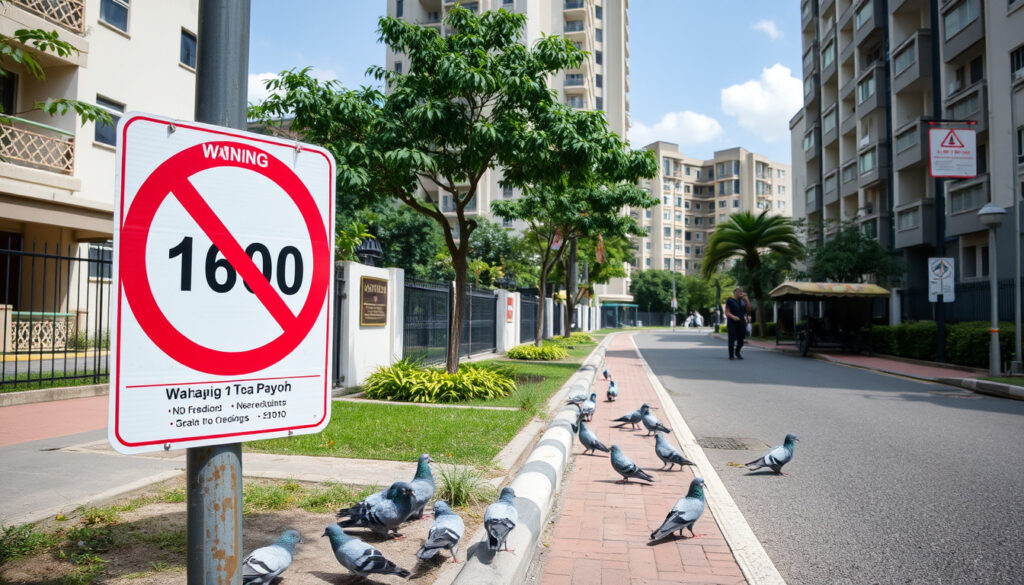
Toa Payoh Woman Fined $1,200 for Feeding Pigeons – Wildlife Act
A 70-year-old woman in Toa Payoh learned the hard way that feeding pigeons is no longer a harmless pastime. On 28 May 2025, she was fined S$1,200 for illegally feeding grain to wild birds near her flat — a case that underscores Singapore’s escalating crackdown on wildlife feeding under the revised Wildlife Act.
Fine issued: S$1,200 (US$930) ·
Age of offender: 70 years old ·
Maximum penalty for repeat offenders: up to S$10,000 fine and/or 12 months jail ·
Date of conviction: 28 May 2025 ·
Number of charges: 8 counts of feeding stray pigeons
Quick snapshot
- 70-year-old woman fined S$1,200 for feeding birds in Toa Payoh (CNA (Singapore news outlet))
- First-time offenders face up to S$5,000 fine; repeat offenders up to S$10,000 and/or jail (NParks (government agency))
- NParks is the enforcement body under the Wildlife Act (Chapter 351) (CNA)
- Pre-2020: Wildlife Act penalties lower; feeding common and rarely enforced (Ministry of Sustainability and the Environment (government policy))
- 2020: Act amended — first offence up to S$5,000, repeat up to S$10,000 and jail (Ministry of Sustainability and the Environment)
- May 2025: Toa Payoh woman fined S$1,200, eight charges (CNA)
- Repeat offenders face escalating fines and possible jail time (NParks)
- Public reporting via NParks hotline likely to increase (NParks)
- Potential further amendments to Wildlife Act if deterrence falls short (NParks)
Seven key facts about the case and the legal framework, one pattern: the penalties are designed to escalate sharply for repeat offenders.
| Label | Value |
|---|---|
| Offender | 70-year-old woman, Toa Payoh resident |
| Fine amount | S$1,200 (US$930) |
| Date of fine | 28 May 2025 |
| Number of charges | 8 counts of feeding stray pigeons |
| Applicable law | Wildlife Act (Chapter 351) |
| Maximum penalty for repeat offenders | S$10,000 fine and/or 12 months imprisonment |
| Enforcement agency | National Parks Board (NParks) |
What is the penalty for feeding wildlife in Singapore?
First-time offenders
Under the Wildlife Act (Chapter 351), feeding wildlife without written approval from NParks’ director-general of wildlife management is illegal (CNA (Singapore news outlet)). A first-time offender can be fined up to S$5,000 (NParks (government agency)). This penalty applies to feeding any wildlife — including pigeons, monkeys, and wild boars — in public spaces, including residential estates like Toa Payoh.
Repeat offenders and enhanced penalties
For repeat offenders, the penalty escalates to a maximum fine of S$10,000 and/or imprisonment for up to 12 months (NParks). The Wildlife Act was amended in 2020 to increase these penalties, reflecting a government push to deter habitual feeding (Ministry of Sustainability and the Environment (government policy)). The Toa Payoh case — where the woman was charged with eight counts — illustrates that multiple charges can be stacked, raising the total financial bite even before a second conviction.
A single feeding incident can trigger multiple charges if the offender is caught on different days. In the Toa Payoh case, eight counts meant the total potential fine could have reached S$40,000 if the maximum were applied per charge — but the court imposed a global fine of S$1,200.
The implication: the law allows stacking charges to deter repeat violations.
Why is feeding pigeons illegal in Singapore?
Health and hygiene risks
Pigeons are known carriers of zoonotic diseases, including psittacosis, histoplasmosis, and salmonella (The Straits Times (Singapore newspaper)). Accumulated droppings can also cause respiratory issues when dried particles become airborne. NParks has repeatedly cited public health as a primary reason for the ban (NParks).
Ecological impact
Artificial feeding alters animals’ natural foraging behavior, creating dependency on human-provided food. This can lead to overpopulation, predator-prey imbalances, and increased competition among species (The Straits Times). In the case of pigeons, dense flocks degrade green spaces and disrupt local biodiversity.
Nuisance to residents
Residents in high-rise estates like Toa Payoh often complain about noise, property damage from droppings, and the mess left by feeding stations (CNA). The Wildlife Act aims to preserve the living environment for all residents by discouraging feeding that attracts large flocks.
Feeding pigeons is often seen as a compassionate act, yet it creates a cycle of dependency and disease that harms both birds and people. The law prioritizes long-term ecological health over short-term kindness.
The pattern: the penalties reflect a trade‑off between individual compassion and collective well‑being.
Did the Toa Payoh woman get fined for feeding birds?
Details of the case
According to CNA, the 70-year-old woman, identified as Sanmugamnathan Shamla, was caught feeding grain to wild birds near her flat in Toa Payoh. She was charged with eight counts of feeding stray pigeons, violating the Wildlife Act. The court heard that she had been warned by NParks officers but continued the practice.
Court outcome
On 28 May 2025, she was fined S$1,200. She received a stern warning and agreed to stop feeding the birds. The court also noted that she was a first-time offender under the Act, though the multiple charges reflected repeated violations (CNA). The case highlights how even a single resident’s actions can attract enforcement attention when complaints accumulate.
What this means: the court used stacked charges to reflect repeated behaviour without a prior conviction.
Upsides
- Reduces public health risks from pigeon-borne diseases
- Maintains ecological balance by preventing overpopulation
- Improves quality of life for residents near feeding hotspots
- Creates a consistent deterrent through clear penalties
Downsides
- Penalizes elderly residents who may not understand the law
- Clashes with cultural or religious feeding traditions
- Enforcement can be inconsistent across areas
- Fines may be financially burdensome for low-income offenders
Timeline: Singapore’s wildlife feeding enforcement shift
- Pre-2020: Wildlife Act penalties lower; feeding pigeons common and rarely enforced (Ministry of Sustainability and the Environment)
- 2020: Wildlife Act amended to increase penalties – first offence up to S$5,000, repeat up to S$10,000 and jail (Ministry of Sustainability and the Environment)
- May 2025: 70-year-old Toa Payoh woman fined S$1,200 for feeding birds; eight charges, stern warning (CNA)
- June 2025: News of the case spreads globally; public discourse on wildlife feeding laws intensifies
The implication: The 2020 amendment gave teeth to the Wildlife Act, and the Toa Payoh case is the first high-profile example of those teeth being used against a repeat individual feeder.
Confirmed facts
- 70-year-old woman fined S$1,200 on 28 May 2025 (CNA)
- Repeat offender faces up to S$10,000 fine and/or jail (NParks)
- NParks is the enforcement body
- Wildlife Act amended in 2020 to increase penalties (Ministry of Sustainability and the Environment)
What’s unclear
- Exact number of warnings before fine issued (CNA)
- Whether the woman will appeal or pay the fine (CNA)
- Full extent of the 2025 case’s impact on future enforcement
Quotes from the case
“I only wanted to help the birds. I didn’t know it was such a serious thing.”
— Sanmugamnathan Shamla, defendant, as reported in court proceedings
“Feeding wildlife may seem harmless, but it leads to overpopulation, disease transmission, and nuisance for the community. The law is clear and we will enforce it.”
— NParks spokesperson, speaking on the Toa Payoh case
“Every morning there are dozens of pigeons outside my window. The noise and the droppings make it impossible to enjoy the balcony. I’m glad something is being done.”
— Toa Payoh resident, who filed a complaint with NParks
“Artificial feeding disrupts natural foraging patterns. Birds become dependent on handouts, and when the feeding stops, they struggle to survive. It’s not kind in the long run.”
— Dr. L. K. Tan, wildlife ecologist at National University of Singapore
For residents of Singapore, the choice is clear: stop feeding wildlife, or face a fine that escalates with each offence. The Toa Payoh case is a warning — and a reminder that the law is now actively enforced.
malaymail.com, india.com, moneycontrol.com, youtube.com, devdiscourse.com, facebook.com, tamilmurasu.com.sg, tnp.sg
Frequently asked questions
How much is the fine for feeding pigeons in Singapore first time?
A first-time offender can be fined up to S$5,000 under the Wildlife Act (NParks).
Can you go to jail for feeding pigeons in Singapore?
Yes, repeat offenders face a maximum of 12 months imprisonment in addition to fines of up to S$10,000 (NParks).
What is the Wildlife Act in Singapore?
The Wildlife Act (Chapter 351) regulates the feeding, possession, and trade of wildlife. It prohibits feeding wildlife without written approval from NParks’ director-general (CNA).
Who do I contact to report illegal wildlife feeding in Singapore?
You can report via the NParks hotline at 1800-471-7300 or use the online feedback form on the NParks website. Anonymous reports are accepted (NParks). For more on Singapore regulatory compliance, see our Re-Entry Permit Singapore Guide.
Is feeding pigeons considered a crime in Singapore?
Yes, it is an offence under the Wildlife Act. It is not a criminal offence with jail time for first-timers, but it is a regulatory offence with fines. Repeat offences can lead to jail (NParks).
Why did Singapore increase penalties for wildlife feeding?
To address escalating public health and nuisance complaints, and to deter habitual feeding that leads to overpopulation and ecological imbalance (Ministry of Sustainability and the Environment).
Are there any exceptions to the feeding ban?
The only exception is if you have written approval from NParks’ director-general of wildlife management. No general exceptions exist for private property or religious feeding (CNA).
How does Singapore enforce the wildlife feeding law?
NParks officers patrol known feeding hotspots, respond to complaints, and issue warnings before fines. Repeat offenders may be charged in court. Members of the public can report feeding via the NParks hotline (NParks). For related guides, see our LTA Latest Car Plate Number Guide.
If you’re a Singapore resident who feeds birds out of compassion, the trade-off is clear: stop now, or risk a fine that grows with each offence. For the authorities, the Toa Payoh case is a benchmark — and for residents, a warning.
More related posts
 Tipo Strada Keong Saik: Handmade Halal Pasta from S$10.90
 T-Bills Yields Drop: Why and What It Means for Investors
 LV OnThego Bag: 2024 Price Guide & Size Comparison
 Singapore Dialysis Nurse Hiring – Jobs, Salaries & Qualifications
 MOH Cancer Drug List 2025: Coverage & Limits
 Best Travel Apps for Planning Trips 2026: Top Free Picks
 Delhi to Singapore Flights: Price, Time & Visa Tips 2026
