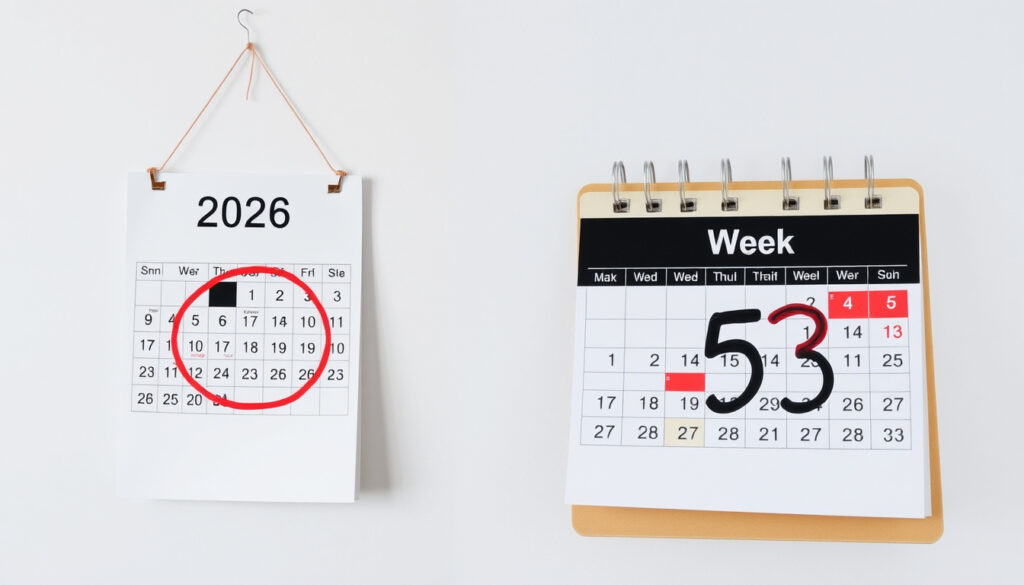
How Many Weeks Are in a Year? 52 or 53? 2026 Explained
The standard answer of 52 weeks in a year is technically short by one day. A common year like 2026 runs 365 days — 52 weeks plus one extra day — and sometimes that extra day builds into a full 53rd week.
Weeks in a common year: 52 weeks + 1 day (Printable Tree) ·
Years with 53 weeks: Approx. every 5–6 years (Wikipedia) ·
Next year with 53 weeks: 2026 (Calendar.best)
Quick snapshot
- A common year has 52 weeks and 1 day (WhatWeekIsIt.org)
- A leap year has 52 weeks and 2 days (derived from ISO rules) (WhatWeekIsIt.org)
- 2026 has 53 weeks under ISO numbering (Calendar.best)
- Whether week 53 is counted in all business contexts — some payroll systems treat it as part of the following year.
- Week 53 of 2026 runs from December 28, 2026 to January 3, 2027 (Calendar.best)
- ISO week 1 of 2026 begins on December 29, 2025 (Weeknumber.com)
Six straightforward facts about year lengths and week counts — one pattern: the number of weeks depends on whether the year starts on a Thursday (common) or Wednesday (leap).
| Label | Value |
|---|---|
| Common year days | 365 |
| Leap year days | 366 |
| Weeks in common year | 52 weeks plus 1 day |
| Weeks in leap year | 52 weeks plus 2 days |
| Next 53-week year | 2026 |
| ISO week start day | Monday |
Are There 52 Weeks a Year?
The most common answer is yes — but the full picture includes a leftover day (or two). A year of 365 days contains exactly 52 full weeks of 7 days each, leaving 1 extra day. In a leap year, there are 2 extra days. That’s why the phrase “52 weeks” is a near‑miss: it’s correct but not complete.
How many days are in a year?
A common year has 365 days. As Printable Tree notes for 2026, that year also has 365 days — a typical common year. A leap year, by contrast, has 366 days, with the extra day falling on February 29. The Wikipedia ISO week date page explains that a leap year can start on a Wednesday, which triggers a 53‑week year.
How many weeks and days are in a year?
Take 365 ÷ 7 = 52.1429, meaning 52 full weeks plus 1 day. The extra day collects quarters of a day over four years to form a leap day. For a leap year, 366 ÷ 7 = 52.2857 — 52 weeks plus 2 days.
Why is the answer 52 weeks and 1 day?
The seven‑day week doesn’t divide evenly into a 365‑day solar year. ISOWeeks.com confirms that the ISO week‑numbering system accounts for this by design: week numbers run either 52 or 53, depending on the year’s starting day.
The implication: any system built on a strict 52-week year will misalign with the calendar by at least one day annually, requiring periodic correction.
How Many Weeks in a Leap Year?
A leap year adds one extra day to the calendar, pushing the week count to 52 weeks and 2 days. The extra day shifts the starting day of the following year, which can create a 53‑week year under ISO rules.
What is a leap year?
Leap years keep the calendar aligned with the astronomical year. The rule: every year divisible by 4 is a leap year, except centurial years not divisible by 400. For example, 2000 was a leap year, but 1900 was not.
How often does a leap year occur?
Roughly every four years. In a 400‑year Gregorian cycle, there are 97 leap years. As Wikipedia indicates, that same cycle contains 71 years with an extra 53rd ISO week.
Does a leap year have 52 weeks and 2 days?
Yes. With 366 days, you get 52 full weeks plus 2 extra days. The two extra days shift the starting day of the next year, which is why leap years can produce 53‑week years when they start on a Wednesday.
If a leap year begins on Wednesday, it will contain 53 ISO weeks — a fact that payroll and project planners need to flag years in advance.
The pattern: a leap year’s starting day ripples forward to create 53-week years that businesses should identify and prepare for well ahead of time.
Is It 52 or 53 Weeks in a Year?
The answer depends on which calendar system you use. For most everyday purposes, a year has 52 weeks plus a day. But under the ISO week date standard, a year may officially contain 53 weeks.
When does a year have 53 weeks?
An ISO week‑numbering year has 53 weeks if January 1 falls on a Thursday (common year) or on a Wednesday (leap year). ISOWeeks.com explains that week 1 is the week containing the first Thursday of the year — this rule determines whether a year ends with 52 or 53 weeks.
Why will 2026 have 53 weeks?
January 1, 2026 is a Thursday. Because the year starts on a Thursday, the first Thursday rule pushes week 1 to start in late December 2025, and the year ends with a 53rd week that spills into early 2027. Calendar.best explicitly labels 2026 as “a list of 53 weeks” under ISO‑8601. WhatWeekIsIt.org confirms that 2026 has 53 weeks because January 1 is a Thursday.
What is ISO week numbering?
ISO 8601 defines a week‑numbering system where weeks start on Monday. Week 1 is the week containing the first Thursday of the Gregorian year. The system is widely used in business and government for fiscal planning. Wikipedia notes that an ISO year can have 364 or 371 days, depending on whether it has 52 or 53 weeks.
An ISO week‑numbering year has either 52 or 53 full weeks.
How Many Weeks Are in a Year Around the World?
While the calendar year length is consistent, the number of weeks and how they are counted varies by culture and business practice.
Which day of the week starts the week in different countries?
In much of Europe and in ISO standards, Monday is the first day of the week. In the United States and parts of Latin America, Sunday is considered the first day. This difference affects how week numbers align with the calendar year.
How do week numbers vary by country?
Countries that follow ISO 8601 (most of the world) use the same week‑numbering rules. However, some financial and retail sectors use 4‑4‑5 calendars or other variations that break the year into 52 weeks regardless of the ISO count. The result: the same year can have 52 weeks in one accounting system and 53 in another.
Do all countries use the same calendar?
No. The Gregorian calendar is the global civil standard, but the Ethiopian calendar has 13 months (12 of 30 days plus a short month), and the Islamic Hijri year has 354 or 355 days — producing about 50.5 weeks per year. For global business, ISO week numbers offer a common reference.
Even in countries that use the Gregorian calendar, the start‑of‑week convention changes week numbering. A 53‑week year can appear in some systems but not others, creating cross‑border confusion for multinational teams.
What this means: multinational teams should agree on a single week-numbering standard — ideally ISO 8601 — to prevent scheduling and payroll mismatches during 53-week years.
Why Is There No Longer 13 Months in a Year?
Ancient calendars sometimes had 13 months, but the Gregorian reform settled on 12. The shift was driven by the desire to keep Easter calculations consistent with the spring equinox.
What was the 13‑month calendar?
Some lunisolar calendars, such as the pre‑Julian Roman calendar, included an intercalary month (Mercedonius) to align lunar months with the solar year. The Jewish and Chinese calendars still add a leap month periodically.
Why did the Gregorian calendar replace it?
The Julian calendar introduced the 12‑month year and a simple leap‑year rule, but it drifted by about 11 minutes per year. By the 16th century, the drift reached 10 days. Pope Gregory XIII reformed the calendar in 1582, skipping 10 days and refining the leap‑year rule. The Gregorian calendar now has 12 months, with months lengths that vary from 28 to 31 days.
What happens every 400 years?
Under the Gregorian system, three leap years are omitted every 400 years (centurial years not divisible by 400). This keeps the calendar nearly in sync with the solar year. The 400‑year cycle also produces exactly 71 years with a 53rd ISO week, as Wikipedia describes.
2026 has 53 weeks because January 1 is a Thursday.
Confirmed facts vs. what’s unclear
Confirmed facts
- A common year has 52 weeks and 1 day.
- A leap year has 52 weeks and 2 days.
- 2026 has 53 weeks under the ISO scheme.
What’s unclear
- Whether the 53rd week is counted in all business contexts — some payroll systems treat it as part of the following year.
For anyone using week numbers for payroll or planning, the 53‑week year adds a wrinkle: 2026 will have 53 ISO weeks, meaning year‑end systems must account for the extra week. Payroll departments using ISO weeks have to decide how to handle week 53 — treat it as part of 2026 or shift it into 2027. The choice has practical consequences for fiscal reporting.
webcal.guru, isoweeks.com, calendar.online, printabletree.com
Frequently asked questions
How many weeks are in a year 2025?
2025 is a common year starting on Wednesday, so it has 52 ISO weeks. The first week begins December 30, 2024.
How many weeks in a month?
An average month is about 4.3 weeks, but since months have varying days (28–31), no fixed number of weeks fits exactly.
Is a year always 52 weeks?
Not under ISO numbering. A year can have 52 or 53 weeks. Common years starting on Thursday and leap years starting on Wednesday produce 53 weeks.
What is a week number?
A week number identifies each week of the year sequentially (1–53). ISO 8601 defines the rules for assigning week numbers.
How many weeks in a year for payroll?
Many payroll systems use a 52‑week year by default, but 53‑week years require adjustments for weekly pay periods and annual salary calculations.
How many weeks are there in a school year?
Most school years run 36–40 weeks, but the exact count varies by country and curriculum.
Does a leap year have 53 weeks?
Only when the leap year starts on a Wednesday. The next such leap year is 2032. Otherwise, leap years have 52 weeks plus 2 days.
More related posts
 Sengkang Hospital Appointment Hotline: Numbers & More
 DBS Savings Account Minimum Balance Guide
 LV OnThego Bag: 2024 Price Guide & Size Comparison
 Minister of Transport Singapore: Jeffrey Siow and Leadership
 Salat Time in Singapore: Today’s MUIS Prayer Schedule
 Tale of the Nine Tailed: Worth Watching, Ending & Season 3
 Best Free Movie Streaming Sites 2025: Plex, Tubi & More
 Private Diploma in Singapore: Fees, Recognition & Best Courses
