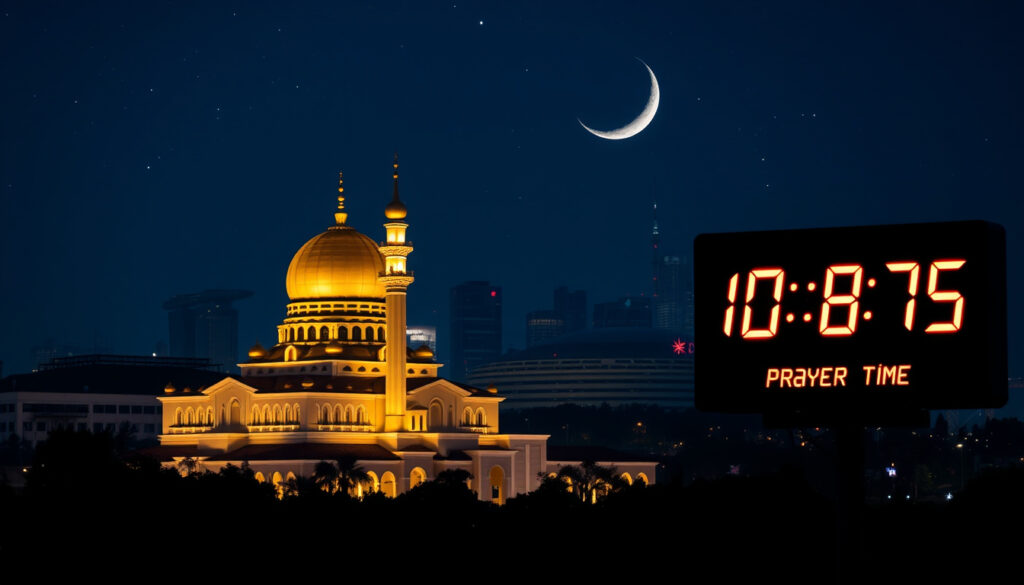
Isyak Time Today in Singapore: Isha Prayer Schedule
Singapore Muslims see different Isha prayer times depending on which app they open, but MUIS (Majlis Ugama Islam Singapura) publishes the official schedule that all mosques follow — and getting that right matters for daily worship.
Fajr: 5:37 AM · Maghrib: 7:07 PM · Isha: 8:19 PM · Official Source: MUIS.gov.sg · Hanafi Asr: 5:24 PM
Quick snapshot
- MUIS lists Isyak at 8:19 PM for a recent May date (MUIS Official Website)
- All Singapore mosques follow MUIS timings via the Shafi’i schedule (Hisar Travel SG)
- MUIS dataset covers the full 2026 year, last updated April 2, 2026 (data.gov.sg)
- May 4, 2026 specific Isyak time not explicitly confirmed on MUIS homepage
- Minor variations may occur across calculation methods (Shafi’i vs. Hanafi)
- Isyak shifts seasonally: 20:25 on Jan 1, 2026, to later in May (data.gov.sg MUIS Dataset)
- Dataset last updated April 2, 2026 on data.gov.sg (data.gov.sg MUIS Dataset)
- Apps sync automatically with MUIS for daily Adhan notifications
- You can verify current times directly at MUIS.gov.sg before Maghrib
The table below summarizes key prayer time data from official Singapore sources.
| Label | Value |
|---|---|
| Isha Time (MUIS) | 8:19 PM |
| Maghrib Time | 7:07 PM |
| Fajr Time | 5:37 AM |
| Authority | Majlis Ugama Islam Singapura |
| Asr (Hanafi) | 5:24 PM |
What time can I pray Isha?
Singapore Muslims refer to the Isha prayer as “Isyak,” and the timing follows MUIS (Majlis Ugama Islam Singapura) guidelines. According to MUIS and cross-referenced data from Muslim Pro and IslamicFinder, the Isha time for a recent May date sits at 8:19 PM, with Maghrib at 7:07 PM — roughly 72 minutes between the two. The MUIS dataset, last updated April 2, 2026, on data.gov.sg, provides the official 2026 timetable covering all twelve months, so you can plan ahead without checking daily.
Current Isha time from MUIS
MUIS publishes beginning times for each prayer. The Singapore Prayer Times App explicitly states that its timings are “based on MUIS – Majlis Ugama Islam Singapura,” syncing with official data so users follow the local Shafi’i schedule used in Singapore mosques. This means the 8:19 PM Isha applies to the entire island — Singapore prayer times are uniform across the country without significant regional variations, as confirmed by MusollahSG, which displays MUIS times for suraus (musollahs) across neighborhoods.
Isha start and end times
The window for Isha prayer technically opens at the listed beginning time and extends until the next Fajr. MUIS calculations use the Shafi’i juristic school, which influences the Asr timing as well. For Singapore, prayer times shift seasonally — the Isyak recorded at 20:25 on January 1, 2026, gradually pushes later through spring, reflecting the changing sunset times. By May, an 8:19 PM Isha aligns with these seasonal patterns.
Can I pray Isha after 12 am?
A common question among Muslims in Singapore concerns praying Isha after midnight — whether it’s permissible and under what conditions. Islamic rulings address this, and the general consensus allows late Isha prayer under specific circumstances, though scholars strongly discourage unnecessary delay.
Islamic rulings on late Isha
Islamic scholars generally permit praying Isha any time after its listed window opens, even if it extends past midnight, for those with valid excuses. However, the preferred (mustahab) time is before the midpoint of the night. Sources on Islamic jurisprudence indicate that delaying Isha beyond midnight without genuine reason is discouraged, as it falls outside the recommended period. For most Singapore Muslims with normal schedules, catching Isha before midnight — around the 8:19 PM MUIS time — keeps you well within comfortable bounds.
Jibreel App Q&A insights
Prayer apps like Muslim Pro and the Singapore Prayer Times App provide not just timings but also educational content addressing common worship questions. These platforms sync with MUIS but also include community Q&A features where users ask about prayer permissibility. The Singapore-specific apps ensure that the calculation method matches what mosques use, so you’re not guessing whether your app aligns with local practice.
What are full prayer times today in Singapore?
Beyond Isha, Singapore Muslims observe five daily prayers: Subuh (Fajr), Syuruk (Sunrise), Zohor (Dhuhr), Asar, Maghrib, and Isyak (Isha). MUIS publishes the complete schedule, and the May 4, 2026 entry shows Subuh at 5:37 AM, Syuruk at 6:57 AM, Zohor at 1:03 PM, with Asar and the evening prayers following standard seasonal patterns.
Fajr, Zuhr, Asr, Maghrib, Isha schedule
The complete prayer schedule for May 4, 2026, as listed on the MUIS homepage, includes: Subuh (Fajr) at 5:37 AM, Syuruk (Sunrise) at 6:57 AM, Zohor (Dhuhr) at 1:03 PM. Asar timing varies by juristic school — the Shafi’i method used by MUIS gives one calculation, while the Hanafi method (often preferred in Singapore’s wider Muslim community) produces a slightly later Asr at 5:24 PM. Maghrib appears at 7:07 PM, followed by Isyak at 8:19 PM. Salatimes.com explicitly uses the “Islamic Religious Council of Singapore (MUIS) calculation method” when displaying Singapore times, confirming alignment across major platforms.
Comparison across sources
While MUIS sets the standard, third-party sites like IslamicFinder and UrduPoint may show slight variations due to update lags or alternative calculation methods. UrduPoint, for example, listed Isha at 08:29 PM for June 23, 2025 — a ten-minute difference from the 8:19 PM seen elsewhere, likely due to the time of year and whether the source specifies MUIS directly. Aladhan.com provides calendar views but does not explicitly specify the MUIS method. For authoritative guidance, MUIS.gov.sg remains the definitive source, with apps like the Singapore Prayer Times App directly syncing from official MUIS data.
What prayer is it now in Singapore?
Determining the current prayer window requires comparing the present time against today’s published MUIS schedule. Several tools help Singapore Muslims track this in real time, ensuring they never miss an Adhan.
Current prayer calculator
The simplest method is checking the current time against the day’s MUIS schedule. If it’s past Subuh (5:37 AM) but before Syuruk (6:57 AM), you’re in the Fajr window. From Syuruk to Zohor (1:03 PM) there’s no prayer, then Asar opens, followed by Maghrib at 7:07 PM and Isyak at 8:19 PM. Apps like Muslim Pro and the Singapore Prayer Times App calculate this automatically based on your device’s location in Singapore, displaying both the current prayer and countdown to the next.
Real-time Azan apps
Singapore prayer apps offer Adhan notifications synced to MUIS times, with options for full Adhan call or Takbir. The Google Play Singapore Prayer Times App, for instance, provides Hijri date adjustments alongside prayer times, helping users track both solar and lunar calendars. MusollahSG displays MUIS timings for suraus throughout Singapore, useful if you’re near a specific musollah (prayer room) and want confirmation of local schedules. These apps pull directly from MUIS, ensuring consistency with what your nearby mosque announces.
Where do most Muslims live in Singapore?
Singapore’s Muslim community, representing about 15% of the 5.9 million population, clusters in specific neighborhoods, with historic areas like Kampong Glam and Arab Street serving as cultural and religious hubs. Understanding where these communities concentrate helps contextualize the prayer infrastructure available across the island.
Kampong Glam and Arab Street
The Kampong Glam area, anchored by the historic Masjid Sultan (Sultan Mosque), sits near Arab Street and is recognized as one of Singapore’s oldest Malay-Muslim quarters. Frommers describes Arab Street and Kampong Glam as areas with the highest concentration of Muslim-related commerce, dining, and worship spaces. This neighborhood hosts numerous prayer rooms, halal restaurants, and the cultural institutions that serve the Muslim community, making it a natural gathering point especially during Ramadan and Hari Raya.
Muslim community hubs
Beyond Kampong Glam, Geylang Serai in the east hosts a significant Malay-Muslim population with community facilities and mosques like Masjid Anwar. Other areas with notable Muslim populations include Bukit Timah, Woodlands, and Bedok, each with mosques or prayer rooms accessible to residents. Muslim.sg, a platform providing Islamic content for Singapore Muslims, often highlights community events across these areas. The dispersed but concentrated nature of Singapore’s Muslim population means prayer facilities are accessible island-wide, with MUIS ensuring standardized timing regardless of which mosque or prayer room you attend.
How accurate are Singapore prayer time apps?
The accuracy question matters because prayer apps vary in how closely they match official MUIS timings. MUIS itself warns about scams using prayer time variations, emphasizing that only muis.gov.sg provides the authoritative schedule.
Apps directly synced to MUIS — like the Singapore Prayer Times App and Muslim Pro — match official timings precisely, while aggregators like UrduPoint may lag by minutes.
App verification methods
The most reliable approach is to verify app times against MUIS.gov.sg before Maghrib. The Singapore Prayer Times App explicitly credits MUIS as its source, and Salatimes.com does the same. If an app shows times that differ from MUIS by more than a minute or two, it may be using an alternative calculation method (like Muslim World League instead of Shafi’i) rather than MUIS directly.
Why official sources matter
MUIS’s dataset covers the full 2026 year and was last updated April 2, 2026, available as an open government resource on data.gov.sg. This transparency allows anyone to download the complete annual schedule, verify specific dates, and confirm calculations. Third-party aggregators may aggregate MUIS data but can introduce minor discrepancies due to update timing. For critical worship decisions, MUIS.gov.sg remains the definitive reference.
A prayer app showing the wrong time could mean you pray outside the prescribed window — MUIS’s official dataset eliminates this risk for Singapore Muslims.
How to check Singapore prayer times?
Multiple reliable channels exist for accessing Singapore prayer times, ranging from government websites to mobile applications. Choosing the right channel ensures you’re working from accurate, up-to-date information.
Direct government sources
The most authoritative channel is MUIS.gov.sg, which displays current daily prayer times on its homepage. The site also offers downloadable PDFs and links to the full 2026 dataset on data.gov.sg, where the dataset was last updated April 2, 2026. This open government data resource allows detailed verification for any date in 2026, making it useful for advance planning or academic research on Singapore prayer time patterns.
Community and app resources
For everyday use, MusollahSG provides prayer times for suraus across Singapore, syncing with MUIS data. Muslim.sg offers Islamic content for Singapore Muslims and often includes prayer-related information. Hisar Travel SG notes that Singapore prayer apps “sync directly with official MUIS timings for accuracy,” with Adhan notifications and Hijri date adjustments available. The key criterion when choosing an app is whether it explicitly credits MUIS as its source — apps like the Singapore Prayer Times App on Google Play do exactly that, while others may use different calculation methods.
Bookmark MUIS.gov.sg as your primary reference, and use apps that explicitly credit MUIS as their source. The implication: when your app credits MUIS and matches the published schedule, you can trust it for worship timing.
The Singapore Prayer Times App explicitly states its timings are based on MUIS, syncing with official data so users follow the local Shafi’i schedule used in Singapore mosques.
— Singapore Prayer Times App (Google Play Developer Description)
MUIS is the official Islamic Religious Council of Singapore responsible for standardized prayer times across all Singapore mosques.
— MUIS Official Website (MUIS.gov.sg)
For Singapore Muslims, the prayer time question has a clear answer: MUIS sets the standard at 8:19 PM for Isha, with the complete schedule from Subuh at 5:37 AM through the evening prayers. Apps and websites that credit MUIS as their source deliver consistent, accurate timings across the island. The dataset is publicly available for verification, updated as of April 2, 2026, and the seasonal patterns — from 20:25 on January 1 to later times in May — show predictable shifts throughout the year.
For those navigating busy schedules, the key takeaway is straightforward: bookmark MUIS.gov.sg, download a MUIS-synced app like the Singapore Prayer Times App, and verify before Maghrib. You don’t need to guess whether your app is correct — if it credits MUIS and matches the published schedule, you’re covered.
Related reading: Salat Time in Singapore · Best Biryani in Singapore
Today’s Isyak at 8:19 PM, along with Fajr and Maghrib, matches the uniform Singapore Muslim prayer schedule that powers mosque announcements and synced mobile apps.
Frequently asked questions
What is the best time for praying Isha?
The best (mustahab) time for Isha prayer is immediately when it opens, as with all daily prayers. MUIS lists the Isha (Isyak) time at 8:19 PM for Singapore, and praying at or shortly after this time follows the Sunnah. Delaying without valid reason is discouraged, though praying after midnight remains permissible with genuine excuse.
What time is Isha in my area?
Singapore uses uniform MUIS timings island-wide, so the Isha time is the same whether you’re in Tampines, Jurong, or Orchard. The 8:19 PM applies across all mosques following the Shafi’i schedule. Minor variations may appear in apps using different calculation methods, but MUIS.gov.sg and MUIS-synced apps provide the definitive answer.
What time does Isha start now?
For a recent May date, Isha starts at 8:19 PM according to MUIS. The dataset shows seasonal shifts — from 20:25 on January 1, 2026, to later times in May — so checking MUIS.gov.sg or a MUIS-synced app gives the specific “now” time for today’s date.
What is Subuh time today in Singapore?
For May 4, 2026, MUIS lists Subuh (Fajr) at 5:37 AM. This shifts seasonally but remains consistent across MUIS-synced sources. The complete morning schedule includes Syuruk (Sunrise) at 6:57 AM.
What is Maghrib timing today in Singapore?
Maghrib (Sunset prayer) begins at 7:07 PM for the recent May date covered by MUIS data. This marks the opening of the Maghrib window, followed by Isyak (Isha) at 8:19 PM.
How accurate are Singapore prayer time apps?
Apps explicitly synced to MUIS, like the Singapore Prayer Times App, match official timings precisely. Apps using alternative calculation methods may show slight variations. The most reliable approach is verifying against MUIS.gov.sg directly or choosing apps that explicitly credit MUIS as their source.
What are prayer times for 2026 in Singapore?
MUIS provides the full 2026 Muslim Prayer Timetable, last updated April 2, 2026, on data.gov.sg. The dataset covers January through December 2026, including seasonal variations. Sample entries show Isyak shifting from 20:25 on January 1 to later times as summer approaches, with Subuh at 5:37 AM and Maghrib at 7:07 PM for the May 4, 2026 date.
More related posts
 Ernst and Young Singapore: Services, Salary & Big 4 Comparison
 China Golden Week 2025: Dates & Travel Tips
 Best Travel Apps for Planning Trips 2026: Top Free Picks
 Aston Villa vs Bournemouth Lineups: Predicted XI & Team News
 Myung Ga II Tanjong Pagar Menu: Prices & Dishes
 Authentic Claypot Chicken Rice Recipe (Malaysian Style)
 DCA International Dental Centre: Services, Photos & Reviews
 Car Rental New Zealand 2025: Cheapest & Best Companies Compared
